
Buying a Sports Car Doesn’t Teach You How to Drive
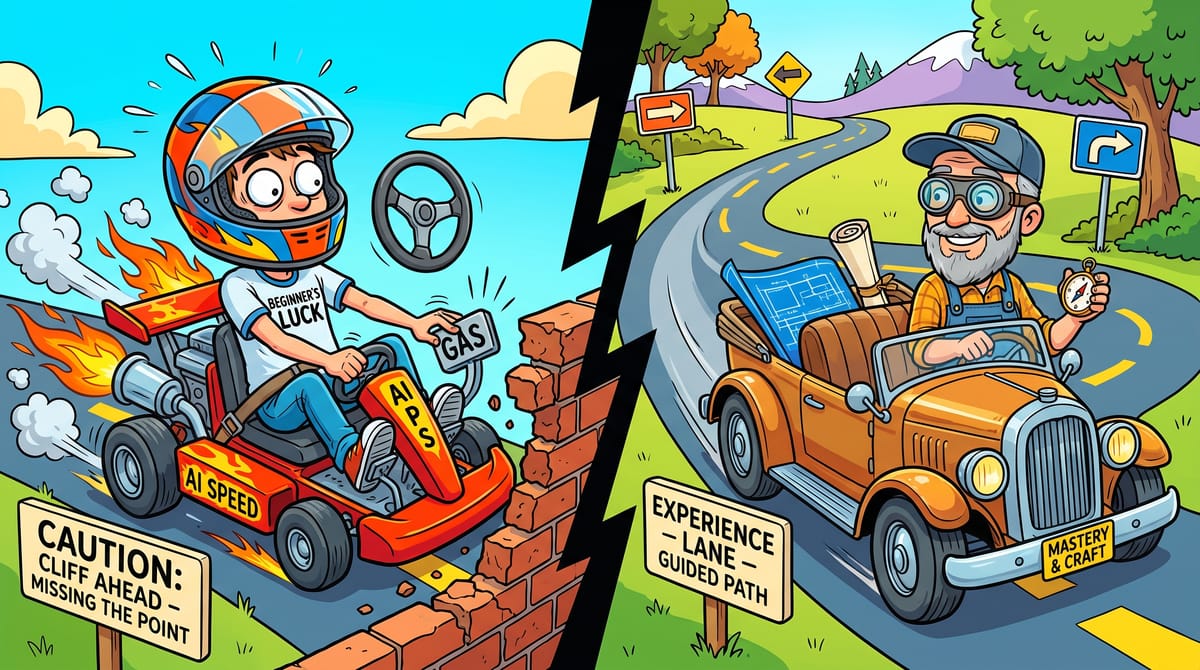
Saying AI makes everyone an instant pro is like buying an expensive sports car and assuming you’re ready for Formula 1. If you don’t know how to steer, all you’ve done is build a much faster way to crash into a wall.
Right now, the internet loves to tell us that AI makes everything dead simple. Just type a little prompt into a box, and presto—you’re a copywriter, a legal researcher, an accountant, and a software developer before lunch.
If you’ve spent ten, fifteen, or twenty years learning how to actually do your job, watching people say that feels a bit insulting. Did all that hard-won knowledge just become useless overnight?
Not even close.
Saying AI makes everyone an instant pro is like buying an expensive sports car and assuming you’re ready for Formula 1. Sure, anyone can push the gas pedal and go 120 mph down a straight road. But the car doesn’t know when the road turns sharp to the left. If you don’t know how to steer, all you’ve done is build a much faster way to crash into a wall.
The Microwave in the Kitchen
Think of AI like a shiny new commercial microwave.
Anyone can walk up to it, shove something in, and press the big button. But if you throw in a frozen steak for twenty minutes, you haven’t cooked dinner—you’ve committed a crime against meat.
A real chef knows what heat does to fat, when to salt, and when to pull the pan off the stove. When someone who doesn't cook uses AI, they see five paragraphs of smooth text and think, "Magic! It's done!"
An experienced pro reads the exact same page and instantly spots what’s wrong: "That clause will blow up our contract, that tax estimate is completely illegal, and our actual customers would never speak this way."
The machine brings the heat. You bring the taste.
The Cheerful, Reckless Intern
The easiest way to think of AI is as an eager intern who has memorized every textbook in the library, works at lightning speed, but has zero common sense.
It’s like asking someone to make sure you get a seat on a crowded morning bus, and their brilliant plan is to pull the emergency fire alarm so everyone runs off screaming. Technically, you got the seat! Mission accomplished! But in the real world, you're about to get arrested.
An automated tool doesn't know context or real-world stakes; it just predicts what looks plausible. Without years of experience, a beginner will take whatever the bot says at face value. An expert spots the bluff in three seconds flat.
The Power Saw Rule
Hand a heavy table saw to a master woodworker, and they’ll turn rough timber into a clean dining table in two days instead of two weeks.
Hand that same table saw to a complete amateur, and they won't build a masterpiece—they'll ruin four hundred dollars of oak and spend the afternoon in the emergency room.
AI doesn't replace the craftsman; it just multiplies how fast things move. If an amateur uses it, they generate massive piles of fast, polite garbage that someone else has to fix. When an expert uses it, they skip the boring typing and admin grunt work so they can focus on the decisions that actually matter.
Knowledge Isn't Gone—It's the Steering Wheel
AI hasn’t made your experience pointless. It has made it the most valuable thing in the room.
When anyone can generate five pages of words or ten slides in thirty seconds, the words themselves aren't special anymore. What matters is knowing what to keep, what to throw away, and what to fix before it reaches a customer.
You didn’t spend years mastering your craft just to be replaced by a chat box. You spent those years learning where the guardrails need to be—so you know how to steer the machine without driving it off a cliff.