
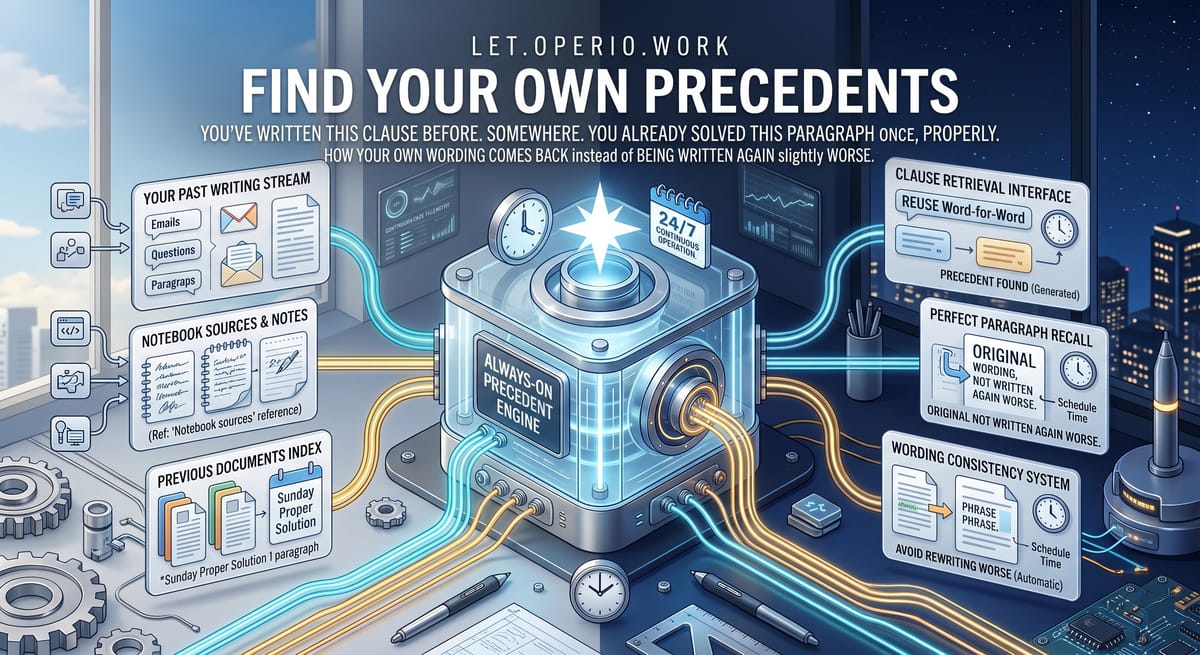
You've written this clause before. Somewhere.
You already solved this paragraph once, on a Sunday, properly. Here's how your own wording comes back to you instead of being written again slightly worse.
You’re four paragraphs into the subcontract when you stop, because you’ve written this paragraph before.
Not something like it. It. The one about who carries the cost when materials arrive late, which you rewrote after the business with the roof tiles, and which took most of a Sunday to get right.
It’s on this machine. It’s in a document whose name you can’t recall, for a client whose name you also can’t recall, from a year you’d have to guess at.
You spend eleven minutes looking. Then you write it again from memory: slightly different, slightly worse.
What rewriting your own words costs
Six agreements a month — engagement letters, subcontracts, statements of work, whatever your version is. Each one has three or four paragraphs you’ve written before and would rather not write again. Twelve minutes each, whether that’s twelve spent searching or twelve spent re-drafting from memory, which is the same twelve minutes with a worse outcome.
That’s around three and a half hours a month. At $60 an hour it’s a bit over $200. If your hour is billable at a professional rate, run the multiplication with your real number — it gets ugly fast, and it’s the same hour either way.
But the hours aren’t the thing. The thing is drift.
Every time you rewrite the delay clause from memory, you produce a version that’s close. Do that eight times and you have eight clauses in circulation, all similar, none identical, and the one that reached the client is whichever you could find that day. Nobody chose it. It won because it was on top.
Which means the paragraph you got exactly right on that Sunday — the one that already survived an argument — probably isn’t the one currently protecting you. It’s in a document from 2023, doing nothing.
There’s a copy-paste version of the same problem, and it’s the one that shows up on a client’s screen. Paragraph nine still says Halloran because Halloran was the last engagement letter you had open.
How it gets handled
Nothing here writes your contracts. It gets your own past work back into your hands at the moment you need it, which is while you’re typing, not after you’ve sent it.
Here’s the order it actually happens in.
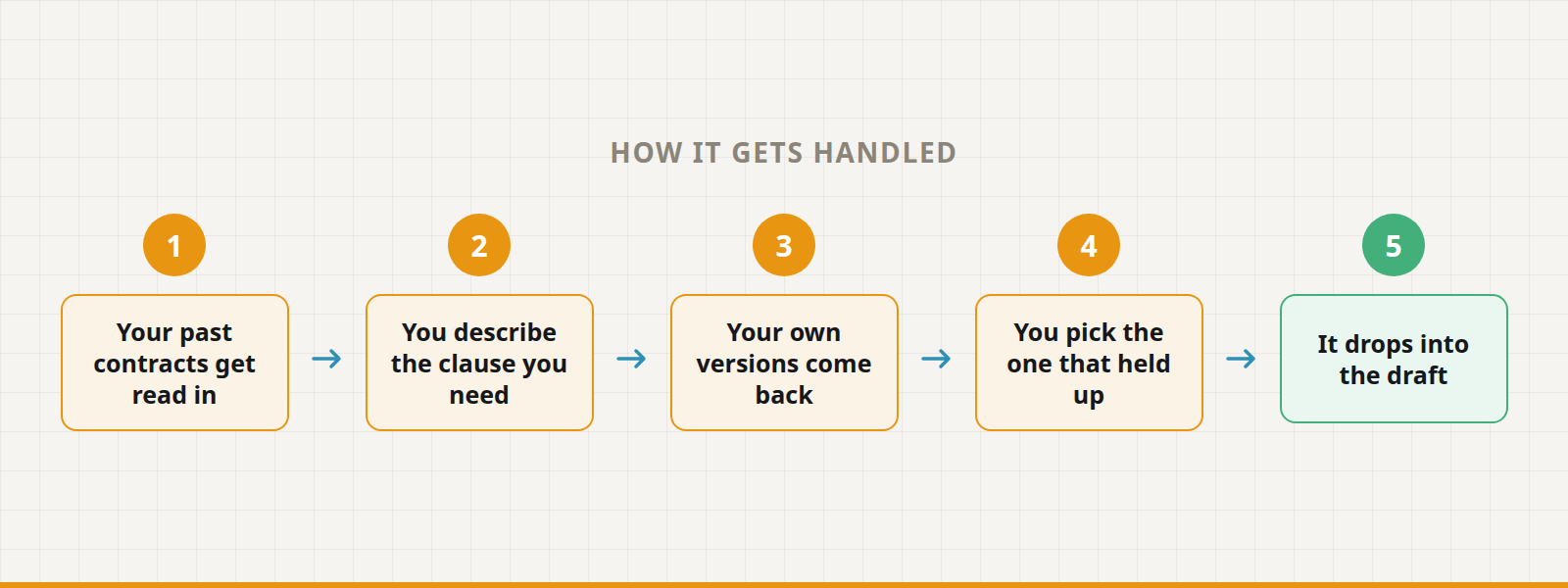
1. Your past contracts get read in. The engagement letters, the subcontracts, the terms you’ve been sending for years. They stay where they are, in whatever folder structure has grown up around them.
2. You describe the clause you need. In plain words: the one about late materials, where the delay cost sits with the supplier. Not a file name. Not a date you don’t remember.
3. Your own versions come back. Side by side, with what they came from and when — the 2023 one, the shorter 2024 one, the one you softened for a client who pushed back.
4. You pick the one that held up. You know which. You mark it once as the version you use, and it stays marked, so the choosing happens once instead of every time.
5. It drops into the draft. With your defined terms matched to this document and the other client’s name gone. That last part is small and saves the specific embarrassment of Halloran appearing in someone else’s agreement.
In the catalog this is the Clause Librarian, and librarian is the right word — it doesn’t write anything, it knows where everything is and which copy is the good one.
A few versions of it:
The employment solicitor. You’ve drafted restrictive covenants for twelve years and they’re all slightly different, because you drafted most of them at speed from whatever was nearest. Ask for the non-compete you use for a sales hire, and you get yours back — including the one narrowed after a client got a hard time about it in front of a tribunal. The good version stops being the one you happen to remember.
The architecture practice. Your scope and fee-stage wording is fine. The risk is mechanical: you copy last month’s appointment, change the header, and miss the paragraph in the middle where the survey exclusion was written for a listed building. The exclusion that comes back is the general one, and the listed-building variant is offered as a separate choice rather than smuggled in.
The recruitment agency. After a placement walked out in week three you rewrote your rebate terms, properly, with the sliding scale and the notice period spelled out. Four sets of terms of business have gone out since with the old version in them, because the old one lives in the template and the template is what everybody copies from. Now the current wording is what surfaces, and the retired one is marked retired.
Your own precedents are only as useful as the file they sit in, and the file starts on the phone — a new client calling, and somebody writing it down properly.
What it won’t do
It isn’t advice. It gives you back your own words; whether those words are right for this client, this deal, this jurisdiction is a professional judgement, and it stays with the professional. Your name’s still on the letter.
It can only return what you’ve written. If you’ve never drafted a decent data protection clause, no amount of searching produces one. It will tell you it has nothing, which is more useful than something confident and invented, and then you’ll want a lawyer for an hour.
It doesn’t know which version is best until you say so. On day one it can show you six and tell you where each came from. Ranking them is you, once, per clause. That afternoon is the actual setup, and it’s the most valuable afternoon in the whole exercise.
And it won’t fix documents that never got written down. If your standard terms live mostly in your head, and each contract is a fresh act of memory, this can’t reach into your head. The first job isn’t search. It’s writing the good version down once.
Stop rewriting the paragraph you already got right.
Operio builds and runs the AI workers that take a job like this off your desk — set up around how you actually work, watched over, and improved as it goes. You approve everything before it reaches a customer.
Or browse the full catalog of specialists to see what else can come off your plate.