
It's forty days late and you still haven't sent the email
The chasing email takes four minutes and never gets written. Here's how the follow-up on a late invoice happens without you having to be the one who sends it.

You’ve checked again. Still nothing.
The job finished on a Tuesday in June. The invoice went out that Friday, which felt quick at the time. It’s forty days on now, and you’ve opened the banking app three times this week to be told the same thing three times.
You know exactly what to do about it. Write the email. Two lines, friendly, just circling back on invoice 1042. Four minutes, tops.
It’s been forty days.
What forty days actually costs
Do the arithmetic on your own month. Say you send twenty invoices and four of them drift past due. Each one needs a first nudge, a second one about a week later, and a phone call if the second gets ignored. Call it ten minutes each, by the time you’ve found the invoice number, checked whether you already chased it, and written something that sounds friendly rather than tight-jawed.
That’s forty minutes a month. If your own hour is worth $60 — and if you’d rather not put a number on it, your accountant already has — you’re spending about $40 of your time asking people for money they already agreed to pay.
The $40 is not the expensive part. The expensive part is that you already bought the materials. You already paid the person who did the work. A late invoice pauses neither of those, so the gap gets covered out of your account, and you carry it quietly for as long as the customer takes.
Then there’s the part that doesn’t show up anywhere. The small drop in your stomach when their name appears in your inbox about something else entirely. The awkwardness next time they ring with work: do you mention it, or let it go and hope. The Sunday evening you spent on the books instead of not on the books, because the books are the only place the whole picture lives.
The chasing email doesn’t get written because it’s the least pleasant four minutes of the week. It isn’t hard. It’s just heavier than four minutes ought to be, and there is always something else to do that isn’t that.
How it gets handled
This doesn’t need a new way of running your business. It needs one job done reliably: watch what went out, notice what hasn’t come back, and say something about it on time and in your voice.
Here’s the order it actually happens in.
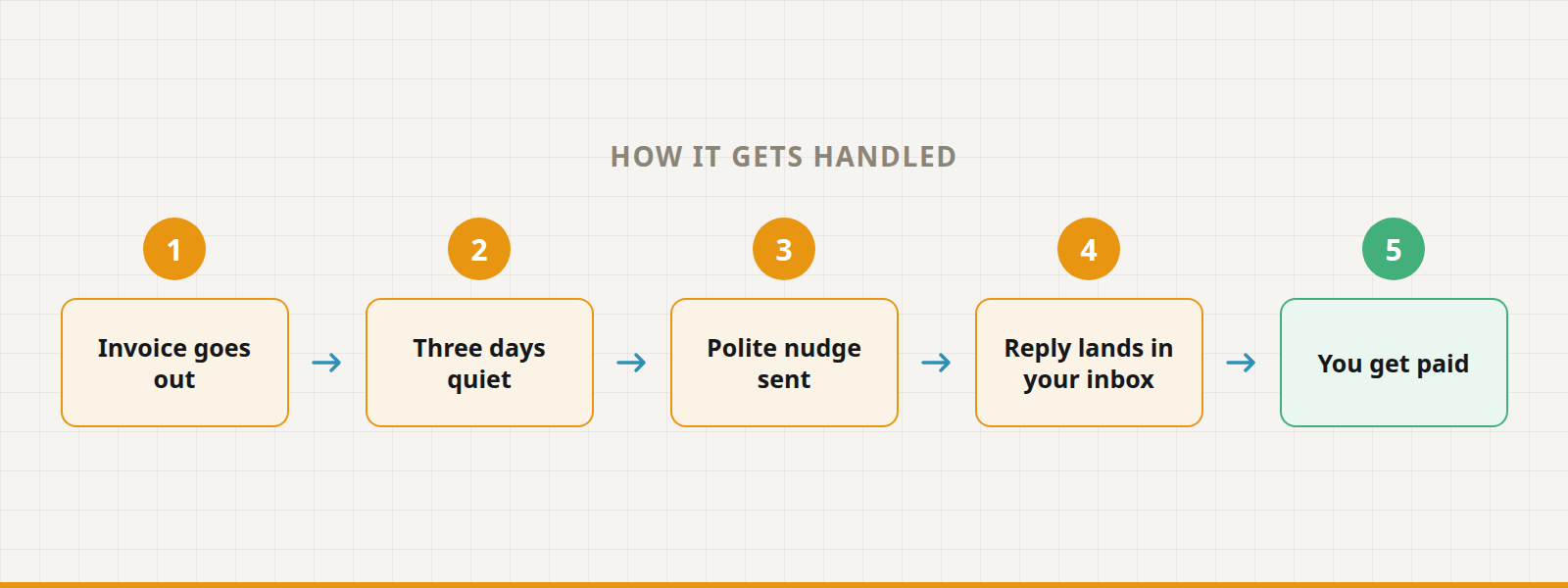
1. Invoice goes out. The moment you raise it, it’s on a list with its due date against it. Nothing about how you invoice changes — same tool, same template, same numbering.
2. Three days quiet. If the money lands, the invoice drops off the list and you never hear about it. If it doesn’t, the clock starts. Three days past due, then a week, then a fortnight: you set that rhythm once, and it’s the rhythm you’d have picked anyway.
3. Polite nudge sent. A short, warm message with the invoice number, the amount, and a link to the invoice itself. The first one assumes it slipped, because it usually did. If a second is needed, that one sits a shade firmer. It sounds like you, because you approved the wording before any of it went anywhere.
4. Reply lands in your inbox. “Sorry, paying today.” “Can we split it over two weeks?” “We never got it.” Whatever comes back arrives with the thread and the history in one place, so you’re not scrolling through six weeks of mail to work out what’s already been said.
5. You get paid. The invoice comes off the list on its own when the payment shows up. Nobody has to remember to close the loop.
In the catalog this one is the Payment Chaser, and polite, persistent, paid is the whole job description. It never gets that hot-faced feeling about the third reminder. That turns out to be the only real qualification the work requires.
A few versions of it:
The electrician. Six invoices out at month end, two of them to a builder who always pays eventually and never pays on time. The nudges go out on day three whether or not you’re up a ladder. By the time you look, one has paid and the other has asked for a fortnight — which is a real answer, and one you can plan around.
The design studio. Your client is lovely; their accounts department is a black hole. The reminders go to accounts, copy the client, and quote the PO number every time, because that’s the thing their system needs before it will release anything. Nobody at your end has to relearn how their system works twice a year.
The physio clinic. Small balances, lots of them. The $40 co-pays that aren’t worth anyone’s afternoon and add up to a number that matters by quarter end. They get chased the same week, gently, with the amount and a link to pay. The front desk never has to make that phone call.
Waiting on somebody else to spend two minutes is a whole genre of problem. A contract that’s been “about to be signed” for two weeks works the same way, and gets handled the same way.
What it won’t do
It doesn’t decide who gets chased. Some customers you’ll want handled with more care than a rule can carry: the one going through a rough quarter, the one whose next job you’d rather keep than collect on this month. That call stays yours. You take them off the list and pick up the phone.
Nothing reaches a customer without your say-so. At the start you read every message before it sends. Most owners keep it that way for a few weeks, settle on wording they like, then let the routine first nudges go out on their own and hold approval on everything else. Where that line sits is your choice, and you can move it back.
It won’t make someone pay who can’t. A reminder is a reminder. If the money isn’t there, you find that out in week one instead of week six — useful, and not remotely the same thing as being paid.
And it can’t fix terms that were wrong to begin with. If you invoice on 60 days, or you don’t take a deposit on jobs that tie up a week of materials, no amount of courteous follow-up is going to save you. That’s a pricing conversation, and it’s yours to have.
Stop chasing that invoice yourself.
Operio builds and runs the AI workers that take a job like this off your desk — set up around how you actually work, watched over, and improved as it goes. You approve everything before it reaches a customer.
Or browse the full catalog of specialists to see what else can come off your plate.