
The contract has been "about to be signed" for two weeks
Nobody is stalling. It's behind a holiday, a second signer and a printer. Here's how a contract gets signed without you being the one who keeps asking.

You think about it at the lights, which is where the unfinished things live.
The contract went out two weeks ago. The client is keen. They said so on the phone Tuesday and they meant it — they asked about start dates, which is not what people do when they’re backing out.
It is still not signed. It’s behind a holiday, or with a director who deals with paperwork on Fridays, or in a printer tray at their office because somebody there decided it had to be printed, and now it’s a physical object in a building you’ve never been to.
What “about to be signed” costs
Two costs. The clock measures one of them.
The time first. A contract that doesn’t sign itself takes maybe four goes: the polite follow-up, the “just checking this landed”, the phone call, the re-send because they can’t find it. Six minutes each, plus the two minutes of working out which version they actually have. Twelve contracts a month, seven of them needing that treatment, and you’re at three hours — around $180 of your own time at $60 an hour, spent asking people to do a thing they’ve already agreed to do.
The other cost is the one that hurts. Nothing starts. Your own average job, whatever that number is for you, sits still for a fortnight — and it doesn’t move two weeks, it moves everything behind it two weeks, because the crew you were holding Monday for now needs feeding somewhere else. The deposit doesn’t land. The materials order waits. Your cash flow is a fortnight behind your sales, permanently, for no reason anyone chose.
And under that, quieter: a deal that isn’t signed is a deal that can still evaporate. Two weeks is long enough for a budget to freeze, a champion to leave, or a competitor to get a hearing. Enthusiasm has a shelf life, and it starts running down the day they say yes.
How it gets handled
The contract is still yours. The terms are still yours. What comes off your desk is the part that isn’t lawyering — knowing who has it, who hasn’t touched it, and saying something about that at the right hour.
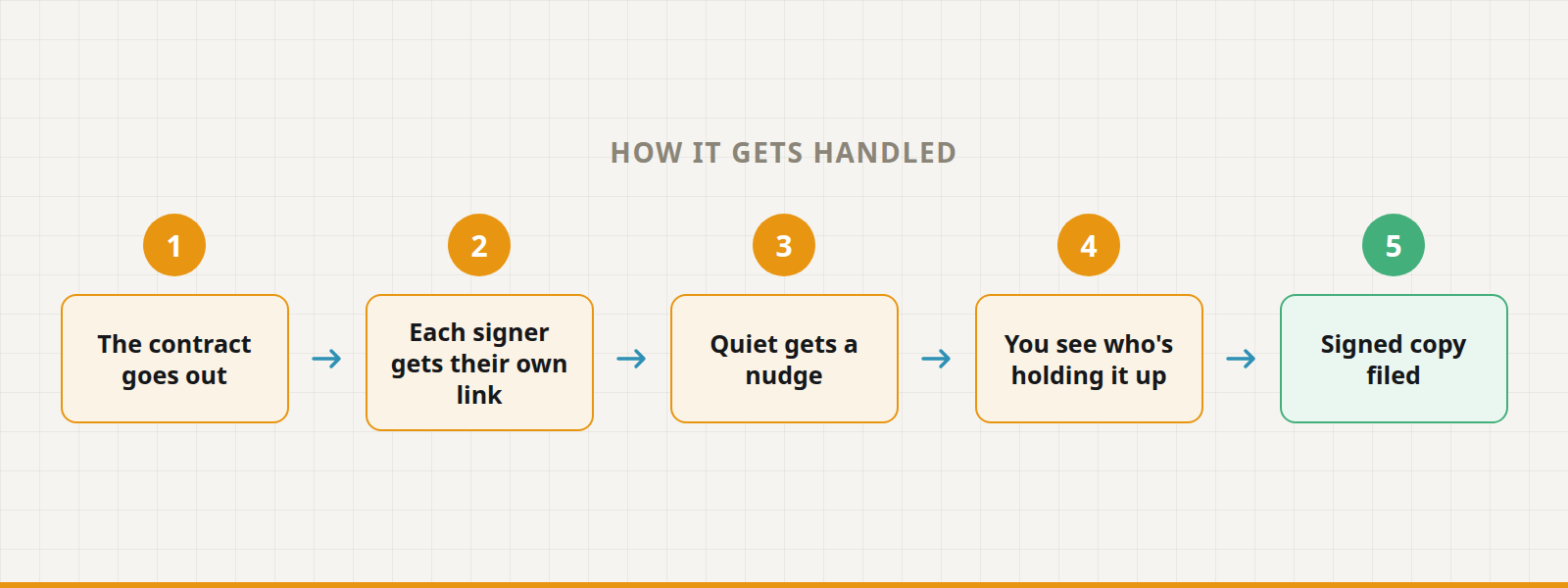
Here’s the order it actually happens in.
1. The contract goes out. Sent for signature the same day it’s agreed, while the phone call is still warm. Not Thursday, when you next sit down at the desk with the good screen.
2. Each signer gets their own link. Named, one each, in order if the order matters. Nobody has to print anything, find a scanner, or photograph a page on a kitchen table at eleven at night.
3. Quiet gets a nudge. Two days, then four, then a week — the rhythm you’d pick yourself. Warm the first time, plain the second, and it goes to the person who hasn’t signed rather than to everyone on the thread.
4. You see who’s holding it up. One line: signed, opened but not signed, never opened. Those are three different problems and they want three different phone calls, and knowing which one you have is most of the job.
5. Signed copy filed. Everyone gets their copy, it lands where your contracts live, and the start date goes in the diary without anyone re-typing it.
In the catalog it’s the Signature Runner. Half of what it does is the bit you’d never build a system for: knowing that a document opened four times and unsigned means something different from one nobody’s touched.
A few versions of it:
The commercial cleaning company. Your contact loves the quote and cannot sign it. The signature belongs to a finance director you’ve never spoken to, two floors up. Both are named on the document from the start, both get their own reminder, and when it stalls you can see it’s stalled upstairs — so the nudge goes there, and your contact never has to be the one chasing their own boss on your behalf.
The IT support firm. Three rounds of redlines and now there are four documents with similar names in circulation. Only the current one is live; the old ones are closed off. That kills the specific disaster where someone signs, cheerfully, a version with last quarter’s response times still in it — which you’d discover during your first serious outage.
The kitchen fitter. Your customer prints it, signs page four, photographs it on the worktop and emails it back. Page two, the one with the payment stages initialled, is missing. Now the ask is one page, sent while they’re still at the table, instead of a fortnight later when the units are on the van and the conversation has become awkward.
Anything that waits on other people to reply behaves like this. Ninety invitations and forty-one replies is the same silence, counted differently.
What it won’t do
Nobody signs because they were reminded. If they’ve gone quiet because the price is wrong or the scope frightened them, prompt reminders bring that up sooner. That’s genuinely useful, and it is not a signature. What you do about a hesitant client is still a conversation you have.
It doesn’t write the contract or check the terms. The words are yours, or your solicitor’s. It moves the document and watches the clock; it has no opinion about your limitation of liability and shouldn’t pretend to.
Nothing goes to a client without your say-so at the start. You approve the covering message and the reminder wording until it sounds like you. Most people then let the two-day nudge run on its own and keep a hand on anything that’s gone quiet for a week.
And it can’t tell you when to stop sending and start dialling. Some silences want a phone call, not a fifth reminder. It will show you which ones look like that — opened six times, signed never — but making the call is a judgement about the person, and that stays yours.
Stop chasing that signature yourself.
Operio builds and runs the AI workers that take a job like this off your desk — set up around how you actually work, watched over, and improved as it goes. You approve everything before it reaches a customer.
Or browse the full catalog of specialists to see what else can come off your plate.