
Your accountant wants the receipts. Again.
The receipts existed. You held every one of them. Here's how they get collected on the day you spend the money, instead of reconstructed in April.

Forty-one.
That’s how many card payments your bookkeeper has no receipt for. It came through on Tuesday with a spreadsheet attached, and the email is polite in the specific way that means this is the third time of asking.
You recognise most of the list. The $86 is the parts counter at Meadowfield. The $31.40 is fuel. The $212 you could not tell anybody about under oath, and it was in March.
The receipts existed. Every one of them. You held them in your hand.
What forty-one missing receipts actually costs
Start with the hours, because they’re the easy part. Your bookkeeper spends two or three hours a month matching payments to paperwork and writing you the email about the ones that don’t match. At $45 an hour that’s around $110 a month you pay someone to ask a question you could have answered in four seconds standing at the counter. Then there’s your own hour going through the van, the wallet, the glovebox and the inbox — another $60 of a Saturday you’re not getting back.
Now the part that isn’t time. A payment with no receipt is money you spent and can’t evidence. If forty-one of them average $50, that’s $2,050 in one month sitting in a category your accountant has to handle carefully, and what exactly that costs you is a question for them. Worth asking out loud, in those words.
Then the year-end version of the same conversation, where the honest answer to most of it is “I don’t know” about things that happened eleven months ago.
And the small stupid one nobody mentions: thermal paper. The receipts that come out of a card machine and fade to a blank strip in a warm van by August. You kept it. It’s still in the door pocket. It says nothing at all now.
How it gets handled
Receipts go missing because filing them is a separate job you do later, and later is where paperwork goes to die. So it stops being a separate job. Thirty seconds, on the day, from wherever you happen to be standing.
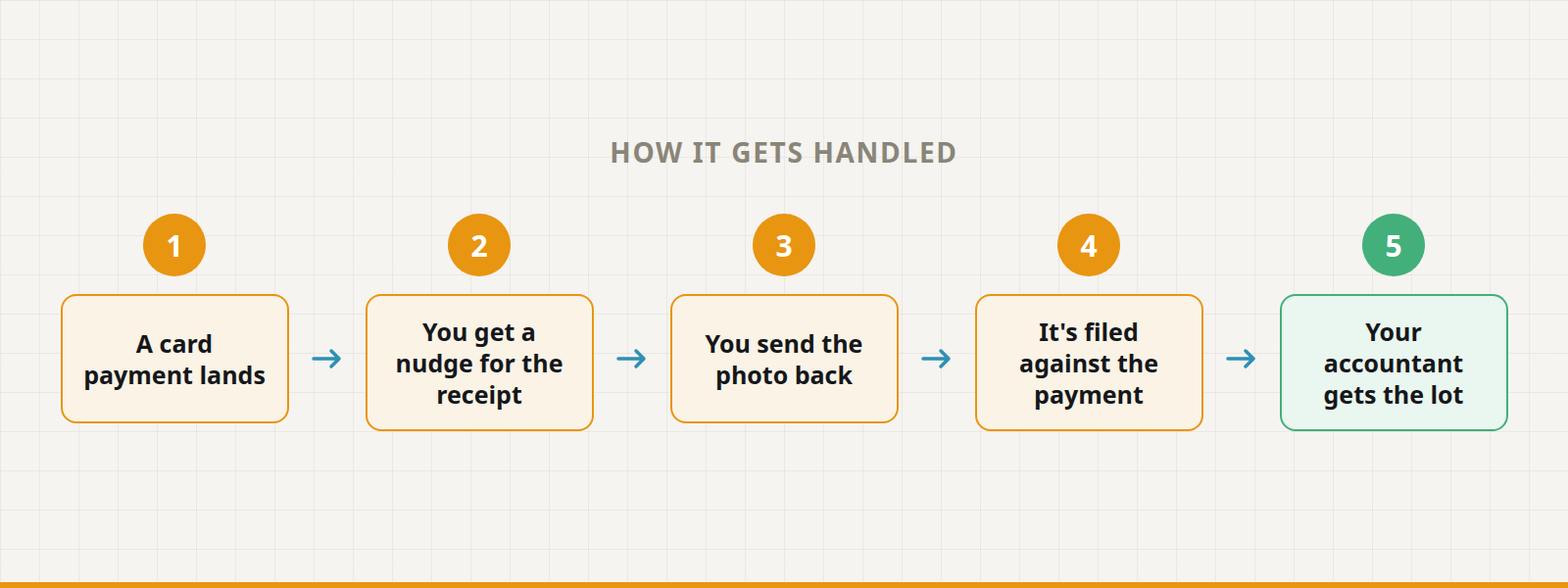
Here’s the order it actually happens in.
1. A card payment lands. The moment it shows up on the account, it’s on a list of things that need a receipt against them.
2. You get a nudge for the receipt. One short message the same day: the merchant, the amount, which card it went on. Not a weekly digest of forty things. One payment, one question, while you can still picture the shop.
3. You send the photo back. Reply with a picture. Crumpled is fine, badly lit is fine. If it came to you by email, forward it instead and it gets picked up from there.
4. It’s filed against the payment. Read, named, dated, matched to the transaction and sorted into the category your bookkeeper actually uses — so the copy that counts is no longer the one fading in your door pocket.
5. Your accountant gets the lot. At month end, everything matched, in one place, in the format they asked for. The email you get back is short.
The catalog calls this one the Receipt Chaser, which is exactly as glamorous as it sounds. It also never feels remotely awkward about asking you for the same thing twice.
A few versions of it:
The mobile mechanic. Four parts counters in a day, four bits of paper, all of them in the door pocket by Thursday and unreadable by August. The photo goes in from the counter before the engine is back together, which takes about as long as putting the receipt in your pocket used to.
The café. Two cash-and-carry runs a week, a card in the hands of whoever’s on shift, and a supervisor who buys milk when it runs out. The problem was never one person forgetting — it’s that four people each remembered a different thing. Every payment asks the person who made it, on the day they made it, so nobody has to reconstruct a week from memory on a Sunday.
The engineering consultancy. Hotels, flights and a great deal of parking, most of it rechargeable to the client under a contract that says receipts have to be attached. A missing receipt there isn’t a tax question, it’s an invoice you can’t raise. The ones marked to a project come back attached to it and leave again on the client’s bill instead of out of your margin.
Receipts are the version of this you owe your accountant. There’s a version you owe your clients too — the document you’ve now asked for four times.
What it won’t do
It doesn’t do your bookkeeping. It collects, reads, files and matches. Whether something is a deductible expense, how it should be treated, what happens at year end — that’s a professional’s judgement, and it stays with the professional you already pay for it.
Nothing goes out without your say-so. It asks you for things; it doesn’t answer on your behalf. If it can’t read a receipt, or the amount doesn’t line up with the payment, it says so and hands it to you rather than quietly filing something wrong.
It can’t produce a receipt that doesn’t exist. If one was never issued, or it went in the bin at the counter, no amount of polite asking brings it back. What changes is when you find out — the same day, while you could still walk back in and ask, instead of in an email in April.
And it won’t fix spending that shouldn’t be on the card in the first place. If personal shopping keeps turning up on the business account, better filing documents that more clearly and nothing else. That’s a rule about who spends what, and you’re the one who has to make it.
Stop finding out in April.
Operio builds and runs the AI workers that take a job like this off your desk — set up around how you actually work, watched over, and improved as it goes. You approve everything before it reaches a customer.
Or browse the full catalog of specialists to see what else can come off your plate.