
You've asked for that document four times
They think they sent it. They sent something else, sideways, in shadow. Here's how the paperwork gets collected and checked without you asking a fifth time.

“Yeah, I sent that over.”
They did not send that over. You’ve been through the inbox twice and the spam folder once, to be fair to them. What arrived on the 12th was a photo of a different page, taken at an angle, half of it in shadow. What you asked for was the signed form and the second bank statement.
That was three weeks ago. This is the fourth time.
They aren’t being difficult. They’re busy, they genuinely believe they’ve dealt with it, and somehow you’re now the one who looks like a nag about a piece of paper neither of you wants to think about.
What the fourth ask actually costs
A normal month has forty documents in it — eight new clients, five each. Half turn up the first time you ask. The other twenty need two goes on average — the reminder, then the one that says no, the other statement, the one with the address on it.
Call each of those messages six minutes, because it isn’t only the typing. It’s opening the folder, working out what’s actually arrived, checking whether the thing they sent is the thing you asked for, and finding a way to ask again that doesn’t sound short. Forty messages, six minutes, four hours a month. At $60 an hour that’s about $240 of you, spent asking people for their own paperwork.
The four hours are the cheap part. While a file is incomplete it doesn’t move. The work doesn’t start, the application doesn’t go in, the deposit doesn’t get taken. You can’t schedule around it either, because the missing page might arrive Tuesday or might arrive in April.
And there’s a first-impression problem nobody talks about. A new client’s first two weeks of knowing you are, right now, mostly you asking them for things. That’s the relationship you’re building while you wait: pleasant person, keeps emailing about a form.
How it gets handled
Nothing here changes what you collect or why. The list stays yours. What changes is that asking, checking and asking again stops being something you personally do at nine at night.
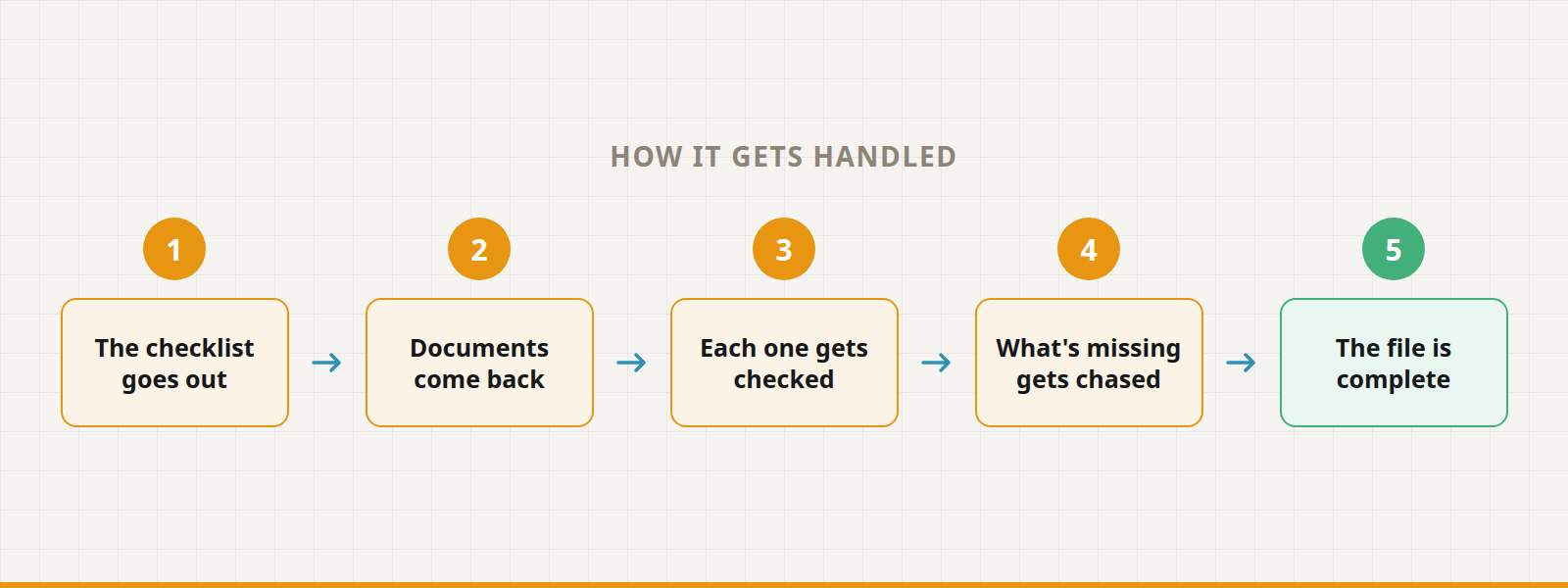
Here’s the order it actually happens in.
1. The checklist goes out. You name the documents a file needs once — for this kind of client, this kind of job. The first message asks for all of them together, in plain words, with an example of what a good one looks like. No portal, no password to reset, no account to create.
2. Documents come back. A link, a phone camera, whatever they’ve got. Most people send paperwork from the sofa at ten at night, and anything that requires them to be at a desk is a week’s delay you’ve built in yourself.
3. Each one gets checked. Is it the right document, is it readable, are all the pages there, is it in date. The photo with the corner cut off gets picked up immediately, not three weeks later when you finally open it.
4. What’s missing gets chased. The reminder names the one thing outstanding. Not “a few outstanding items” — the second bank statement, and here’s what it looks like. The rhythm is yours to set, and it stops the moment the thing arrives.
5. The file is complete. You hear about it once, when it’s whole and checked, instead of eleven times while it isn’t.
In the catalog this one’s the Document Collector, which is a plain name for a job with no glory in it whatsoever. It will ask a seventh time in exactly the same tone as the first, which is not a thing people can do.
A few versions of it:
The mortgage broker. Nothing moves until the file is whole — one missing payslip and the whole application sits at the same stage for a fortnight. The chasing runs across every open case at once instead of whenever you get to it, so a case waiting on one document isn’t also waiting on you to notice it’s waiting. What reaches you is the two files that are genuinely stuck, which are the two worth your afternoon.
The immigration paralegal. Here the problem isn’t silence, it’s what comes back: a passport photographed on a duvet with the bottom line cut off, a certificate that expired in May. Those get spotted on arrival and a better one gets asked for the same day, while the client still remembers where the document is.
The home care agency. Forty carers, and their certifications don’t stay collected — a DBS check, a first aid ticket, a right-to-work document, all with their own expiry dates. The collecting starts six weeks before each one lapses. Nobody is stood down on a Monday morning because a card ran out on Sunday.
The asking-again problem turns up on your side of the desk too, every quarter — the receipts your accountant wants, which existed once and are now a memory.
What it won’t do
The reading is still yours. It checks you got the right one, that it’s legible, that the pages are all there and it hasn’t expired. Whether the numbers on it are any good, whether the reference reads oddly, whether this changes the deal — that’s you, same as now.
Nothing reaches a client without your say-so at the start. You read every request before it sends until the wording is yours. Most people keep approval on the first ask, let the plain reminders run themselves, and never go back.
It won’t get you what someone doesn’t have. Some clients aren’t ignoring you; they can’t find their own statements or the accountant has them. Steady asking finds that out in week one instead of week five, which is useful and is not the same as having the document.
And it can’t fix a list that’s wrong. If you ask for eleven documents when six would do the job, all this does is collect eleven of them faster. Trimming that list is worth an afternoon, and it’s your afternoon.
Stop asking for that document a fifth time.
Operio builds and runs the AI workers that take a job like this off your desk — set up around how you actually work, watched over, and improved as it goes. You approve everything before it reaches a customer.
Or browse the full catalog of specialists to see what else can come off your plate.