
The job's finished. The invoice isn't.
Finished work sitting in a door pocket is money you've earned and nobody has been asked to pay. Here's how the invoice goes out the day the job ends.

There are nine job sheets in the door pocket of the van.
Some are from last week. One is from the week before that, folded into eighths, with a materials list on the back in your own handwriting and half the postcode missing. Every one of them is money you have already earned. Two of them are money you have already spent — the parts are in, the lad’s been paid, the fuel went in the tank.
Nobody has been billed for any of it.
You’ll do them Sunday. You said that last Sunday.
What the ten-day gap actually costs
You can price half of this yourself. The other half is money you’ve already earned and haven’t asked for.
Say you finish fifteen jobs a month, and each invoice takes twelve minutes once you’ve found the job sheet, worked out which materials went where, remembered the extra hour on the Thursday, and typed it all in. Three hours a month, always at the end of a day when there’s nothing left in you. Call it $180 of your own time at $60 an hour, spent on the least interesting task in the business.
The bigger bill is the gap itself. Do this one on your own numbers: how many days pass between finishing a job and sending the invoice for it? If the answer is ten, and you turn over $30,000 a month, then about $10,000 of work you have completely finished is sitting in a door pocket instead of your account. It isn’t late. Nobody has been given the chance to pay it yet.
That money does nothing while your suppliers are on thirty days and your people are on Friday.
Then the part that gets missed altogether. Ten days after a job you remember the price you agreed. You do not remember the second trip for the fitting, the two extra hours, or the sealant you bought on the way. Those never reach the invoice, and the forgetting only ever runs in one direction.
How it gets handled
The invoice isn’t really a separate task. It’s the last two minutes of the job. It only became a separate task because it happens when you’re tired and back in the van with the radio on.
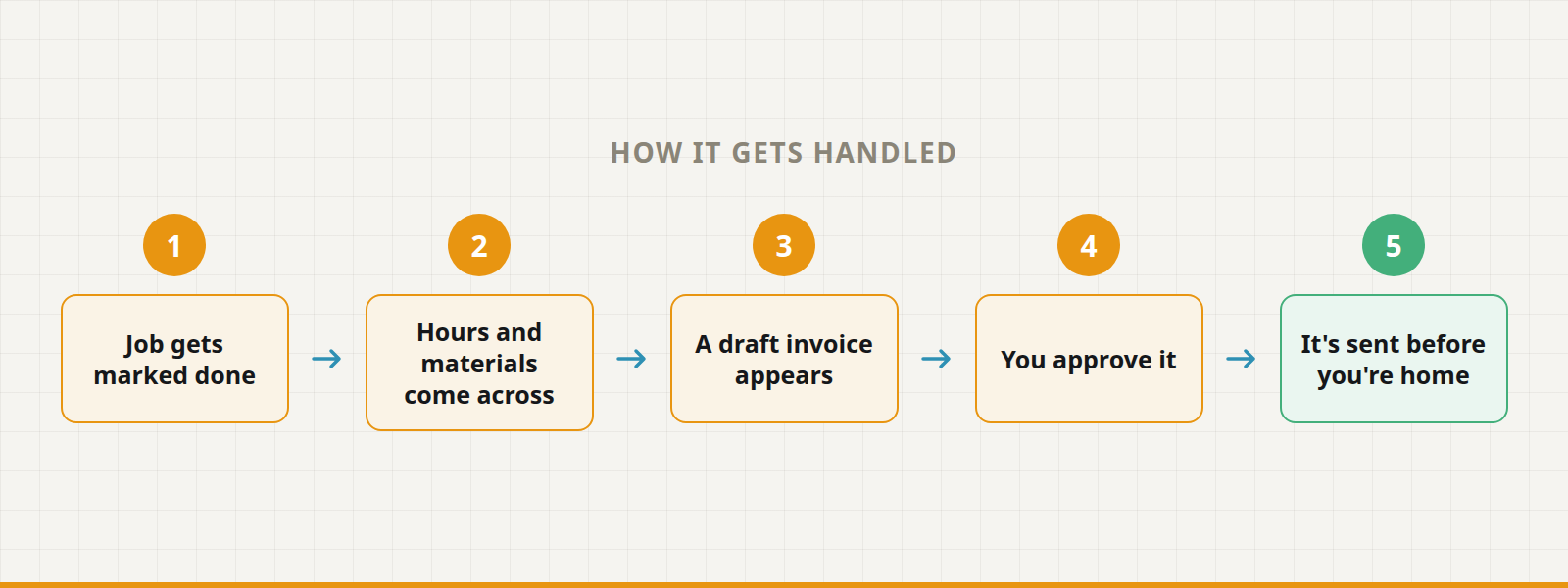
Here’s the order it actually happens in.
1. Job gets marked done. One tap on the phone before you drive off, or it comes off the schedule on its own when the appointment ends.
2. Hours and materials come across. What was quoted, what was actually done, the extra visit, the parts off the supplier’s delivery note. If something’s missing it asks you one short question instead of guessing.
3. A draft invoice appears. Your template, your numbering, your payment terms, the customer’s details already filled in from the job.
4. You approve it. Read it, change the one line you want to change, done. On a normal day that’s under a minute each.
5. It’s sent before you’re home. With a payment link on it, filed into your books, and on the list to be chased if it goes quiet.
The invoice is the end of a job. The start of one is often a Saturday spent ringing round, and finding somebody who can actually come out is the same problem at the other end of it.
In the catalog this one is the Invoice Runner, and the whole job is that gap in the middle. It isn’t a new accounting package either — it’s the one you already pay for, used on the day the work finished rather than a fortnight later.
A few versions of it:
The tree surgeon. You quoted for two trees and took down three, plus a stump, plus a morning of chipping that nobody wrote down anywhere. Ten days later you invoice for two trees, because that’s the number on the quote and it’s the only number you can still see. The draft carries what the crew logged on the day, so the third tree is on the bill before anyone has forgotten it was there.
The landscaping firm. Three crews out, and the person who does the invoicing isn’t on any of them. Every month end opens with the same round of texts asking what actually happened at the Kenton job on the 14th. Here the day’s work comes back from the crew that did it, and month end stops being an investigation.
The IT support outfit. The retainer bills itself. The extras never do. Four hours a month of “while you’re on, could you just—”, all of it real work, none of it on a timesheet anyone enjoys filling in. Logged as it happens, it lands on the next invoice as a line the client can read and understand — a far easier conversation than a surprise at quarter end.
What it won’t do
The number on the invoice is one you already set. The prices come from your quote and your rates. The discount you give a good customer, the hour you write off because the job overran and that was your fault — those are decisions, and it will never make one for you.
Nothing goes to a customer without your say-so. Every invoice waits for your approval to begin with. Most owners keep it that way for a month, watch the numbers keep coming back right, then let the straightforward ones send themselves and hold approval on anything above a figure they pick.
It can’t invoice what nobody recorded. If those extra two hours were never logged — not on the phone, not on the job sheet, not in a message to the office — they don’t exist to it either. This works because the record gets made on the day by the person who was there. It doesn’t work if the record never gets made at all.
And it won’t fix a customer who was always going to pay slowly. Invoicing on the day gives them a full thirty days from a sensible starting point instead of eating a fortnight of it first. What happens after that is a different problem with a different answer.
Stop carrying finished work around in the van.
Operio builds and runs the AI workers that take a job like this off your desk — set up around how you actually work, watched over, and improved as it goes. You approve everything before it reaches a customer.
Or browse the full catalog of specialists to see what else can come off your plate.