
You spent your Saturday finding a plumber
Nine calls, two answers, and a booking the tenant can't make. Here's how one repair reaches three of your own contractors at once and comes back booked.

Saturday was going to be the day you did nothing.
Nine calls. Two answered. One of them can come Thursday. The other quoted a number for a weekend visit that made you laugh out loud in the car, on your own, which is not something you used to do.
Meanwhile the tenant in Flat 3 has water on her kitchen floor and has texted twice, both times politely, which is somehow worse than if she’d been cross.
By two in the afternoon you’ve found somebody. He can come Monday morning if the tenant can be in. The tenant works Mondays.
What a Saturday of ringing round costs
Add up the last one honestly, because it’s never the part you think.
Twenty minutes deciding who to call, which in practice means opening a notes app, a WhatsApp thread from 2023, and a photograph of a van with a phone number on the side. An hour of calls and voicemails and one man who says he’ll ring back. Twenty minutes brokering a time between a contractor who’s free Tuesday morning and a tenant who isn’t. Three quarters of an hour on the phone to the tenant explaining the delay, which is the part that actually takes it out of you.
Call it two and a half hours. At $60 an hour that’s $150 of your time to book one job — and the job itself might cost $180. You are paying nearly as much to arrange the work as to have it done.
Then the money you don’t see. Whoever answers first sets the price, because you have no second quote and no appetite to start again from the top. And a message that arrives on Friday at four and gets read on Saturday morning is a weekend callout instead of a weekday one: same job, different invoice, entirely because of when somebody happened to look at their phone.
The tenant’s opinion of you is also being formed this weekend. Not by who fixes it, or how well. By how long she waited, and whether anybody told her anything while she waited.
How it gets handled
The work here isn’t skilled. It’s ringing round, matching two diaries, and telling three people what’s happening. It just has to happen immediately, and immediately is the one thing a person with a Saturday can’t reliably offer.
Here’s the order it actually happens in.
1. Job comes in. From the tenant, from your inspection notes, from the call you took last night. Address, fault, photos, access — captured once at the start instead of reconstructed across four phone calls.
2. Right trade, right list. Your contractors. The plumber you like for that town, the emergency one you like rather less but who answers, the electrician who’s certified for the block. Not a directory, not a stranger: the list you’d work from yourself, kept somewhere it can actually be used.
3. Three asked at once. The same job goes out to three of them together — what’s wrong, where it is, when the tenant is in, and what you’re willing to pay. Not one at a time with an hour of silence in between.
4. First yes takes the slot. Booked straight into a window the tenant already said worked. No third phone call, no “I’ll check and get back to you”, no Monday morning that the tenant can’t do.
5. Everybody gets told. The tenant gets a name and a time. The contractor gets the address and the access notes. You get one line, and you didn’t have to sit in the middle of any of it.
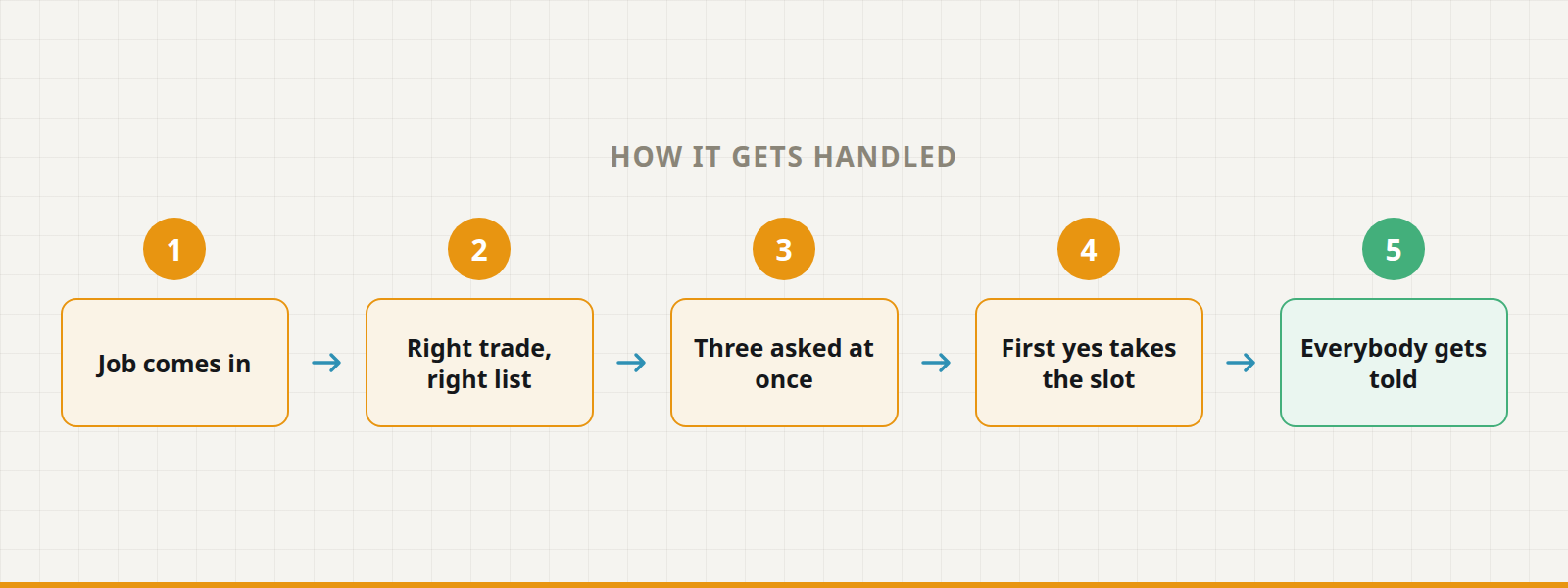
The catalog calls this one the Maintenance Dispatcher, which is a fair description of a job that is mostly a phone and a list.
A few versions of it:
The block manager. The contractor list is four years old. Two have retired, one has moved out of the area, and one only answers on a mobile number you no longer have. You discover this a number at a time, on a Saturday. A list that notices who answers and who doesn’t is a different object entirely — the dead numbers surface themselves in advance, rather than during a leak.
The landlord two hours away. You inherited a house in a town you’ve visited six times. You don’t know a plumber there. You don’t know anyone there. So the first name you find becomes the name you use forever, at the price they name, because finding a second one costs another Saturday. Three quotes on the first job changes the next five years of that property.
The holiday cottage. The job isn’t “sometime this week”. It’s a four-hour changeover between one guest leaving at ten and the next arriving at four, and most contractors can’t work like that. Two of them can. Knowing which two, and reaching them before eleven, is the whole difference between a repair and a refund.
The job gets booked, done and closed on the same day. Whether it gets billed that day is a separate habit — the invoice that goes out before you’re home.
What it won’t do
It doesn’t pick your contractors. The list is yours — people you’ve used, people you’d have in your own house, people whose work you’d put your name to. It won’t go hunting a stranger on a directory site at midnight, because the only thing worse than no plumber is the wrong plumber holding a key.
It can’t produce a tradesman who doesn’t exist. On a Sunday in a small town, three no’s is three no’s. What you get is three no’s inside twenty minutes and a tenant who heard the truth at half past nine — rather than three no’s by two in the afternoon and a tenant who’s been sitting in silence since Friday.
Nothing gets committed without your say-so at the start. You set what can be booked without asking and what has to come to you: a ceiling on spend, particular properties, anything structural. Most owners let the small jobs run themselves within a fortnight and keep approval on everything above a number they choose.
And it can’t fix a maintenance budget that’s too small. If the same repair comes back twice a year because the proper fix costs money you’d rather not spend this quarter, faster dispatch just gets you to the same conversation sooner and more often. It will show you exactly which property that is, in a list, with dates on it.
Stop spending Saturday on the phone.
Operio builds and runs the AI workers that take a job like this off your desk — set up around how you actually work, watched over, and improved as it goes. You approve everything before it reaches a customer.
Or browse the full catalog of specialists to see what else can come off your plate.