
The lease expired and nobody noticed
The tenancy rolled over on terms nobody chose, at a rent you set three years ago. Here's how the renewal starts ninety days out instead of four months late.

The lease for Flat 2 ran out on the 31st of March.
You found this out in July. You were in the folder looking for something else entirely — a certificate, a meter reading — and there it was on page one, a date that stopped you reading page two.
Nothing has gone wrong. The tenant is still there, the rent still lands on the 3rd, everyone is perfectly content. But it lands at the figure you agreed three years ago, on a tenancy that quietly rolled into something neither of you chose, and the conversation you’d have had in February is now a conversation you have to have in July.
What four months of nobody noticing costs
You already know the number for your own flat. Say the rent is $1,400 and the going rate for that flat, honestly assessed, has moved about $80. Four months at $80 is $320 you are not getting back, because there is no version of this where you ask for it retrospectively.
That’s the small number. The bigger one is that the gap doesn’t close on its own. Skip the review three years running — and there’s always a reason to skip it, a boiler, a bad month, a tenant you’d rather not unsettle — and you’re not looking at $80 any more. You’re looking at a number big enough that raising it in one go feels like an ambush, which means you either don’t do it or you do it badly.
Then the admin. Nine tenancies, one renewal each a year. Check the date, decide the rent, write the letter, wait, chase the reply, do the paperwork, chase the signature. Forty-five minutes when it goes smoothly, and it does not always go smoothly. That’s nearly seven hours a year, about $420 of your own time at $60 an hour, spread so thinly across the calendar that it never once looks like a job you could schedule.
And the risk that isn’t money at all. A tenancy that has rolled over is a tenancy that can end on short notice, in February, when nobody in the world is looking to move. You didn’t choose that. You just stopped choosing.
How it gets handled
None of this needs a property management platform. It needs one date, held reliably, and a sequence that starts before the date rather than after it.
Here’s the order it actually happens in.
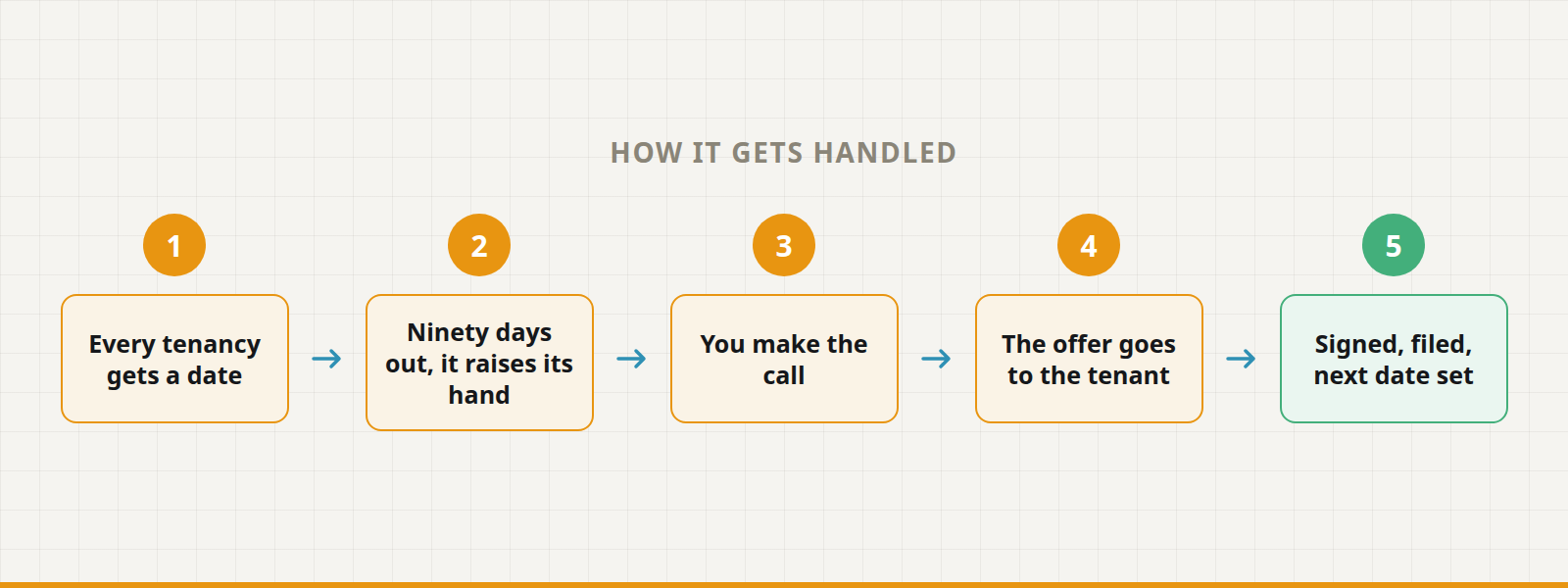
1. Every tenancy gets a date. End date, break clause, notice period, rent review — read out of the leases you already have and put somewhere that isn’t a folder. Including the two you’re not entirely sure about.
2. Ninety days out, it raises its hand. Not on the day. Ninety days, because that’s roughly what a renewal actually takes once you allow for a tenant who takes a fortnight to reply and a signature that takes another one.
3. You make the call. Renew, re-let, or let it end. What rent. Whether this is the tenant you hold at a discount because they’ve never once rung you on a Sunday. It arrives as a short brief — what they pay now, what similar flats are advertised at, how long they’ve been there, whether anything’s outstanding — and then it waits, because this part is yours.
4. The offer goes to the tenant. In writing, in your words, with a date it needs answering by. If nothing comes back it asks again, once at a fortnight and once at three weeks, and you’re told about the silence rather than discovering it in month four.
5. Signed, filed, next date set. The signed copy goes where the last one should have been, and the clock starts again for next year without anybody having to remember to start it.
In the catalog this is the Lease Renewal Manager. It’s a diary that does something about the diary.
A few versions of it:
The four-flat landlord. Four tenancies, four dates, none of them near each other. Nothing is ever due today, which is exactly why nothing ever gets done. Now February and March arrive with two names on them and a suggested rent for each, and the whole year’s reviews take one evening.
The commercial unit. A break clause with a notice period attached, and the notice period is the entire game. Miss it by a week and the term runs another year on terms you’d already decided you didn’t want. The reminder here isn’t a nicety. It’s the difference between making a decision and inheriting one.
The student house. The whole market makes its mind up in November. Ask your current group in February and you’re asking people who signed somewhere else before Christmas. So the conversation moves to October, where it belongs, and the house that used to sit empty until September is let by New Year.
Renewals aren’t the only date that goes quiet on you. The filing that was due yesterday is the same failure, and it’s the one with a penalty attached.
What it won’t do
It doesn’t set the rent. It can tell you what the flat downstairs is advertised at and what yours has done for three years. It cannot tell you that this tenant mows the lawn and has never called you on a Sunday, which is worth real money and appears on no listing site anywhere. You set the number.
Nothing reaches a tenant without your say-so. A renewal letter has your name on it and a rent figure in it, so it waits for you every time — and most owners keep it that way permanently on this one.
It can’t make a tenant stay. Some of them were always going to move, and a well-timed offer means you find that out in November instead of the week the tenancy ends. Four months to re-let instead of four days is most of what you wanted here anyway.
And it can’t rescue a tenancy you should have ended eighteen months ago. If the rent arrives late every month and the neighbours have started emailing you, an on-time reminder gets you to that decision sooner. Sooner is genuinely better. It isn’t the same as easier.
Stop finding out in July.
Operio builds and runs the AI workers that take a job like this off your desk — set up around how you actually work, watched over, and improved as it goes. You approve everything before it reaches a customer.
Or browse the full catalog of specialists to see what else can come off your plate.