
The filing date was yesterday
It was on a calendar. The reminder fired on a day that went wrong at nine. Here's how filings get prepared early instead of depending on you remembering.

It was due on the 15th.
It is the 16th. You found out at 6:04 this morning from an automated email with overdue in the subject line, and for a few seconds — before the coffee, before you’d read the rest of it — you couldn’t remember whether this was the small one or the bad one.
Nobody forgot on purpose. It was on a calendar. The reminder fired at 8 a.m. on a day that went wrong at nine, and by the time you were back at a desk it was a notification you’d already swiped away.
What yesterday costs
There’s a late fee, whatever it is where you are. Pay it and it’s over.
The scramble is the expensive part. A late filing takes about three times as long as an on-time one, because you’re doing it under pressure with the records half-assembled. Call it half a day: four hours of you at $60 an hour is $240, plus whatever your bookkeeper charges to drop what they were doing, plus the two other things that didn’t happen today.
Then there’s the tax you pay for the rest of the year, which never appears on any invoice. Once you’ve been caught out, you check. Two minutes on a Tuesday, five on a Thursday, twenty on a Sunday night going through the folder to be sure nothing’s coming. Twenty minutes a week is seventeen hours a year — over $1,000 of your own time — spent confirming that there’s nothing to do. You’re not buying compliance with those hours. You’re buying a feeling, and it doesn’t even work: you still lie awake in the week before quarter end.
The version that isn’t about money at all: some of these aren’t fees. A licence lapses and you can’t trade. A notice window closes and the right goes with it. Those don’t get worse gradually. They’re fine, then they aren’t.
How it gets handled
This isn’t a smarter calendar. A calendar tells you something is due; that’s the part that was already working. What’s missing is the part where the work is done before the date arrives.
Here’s the order it actually happens in.
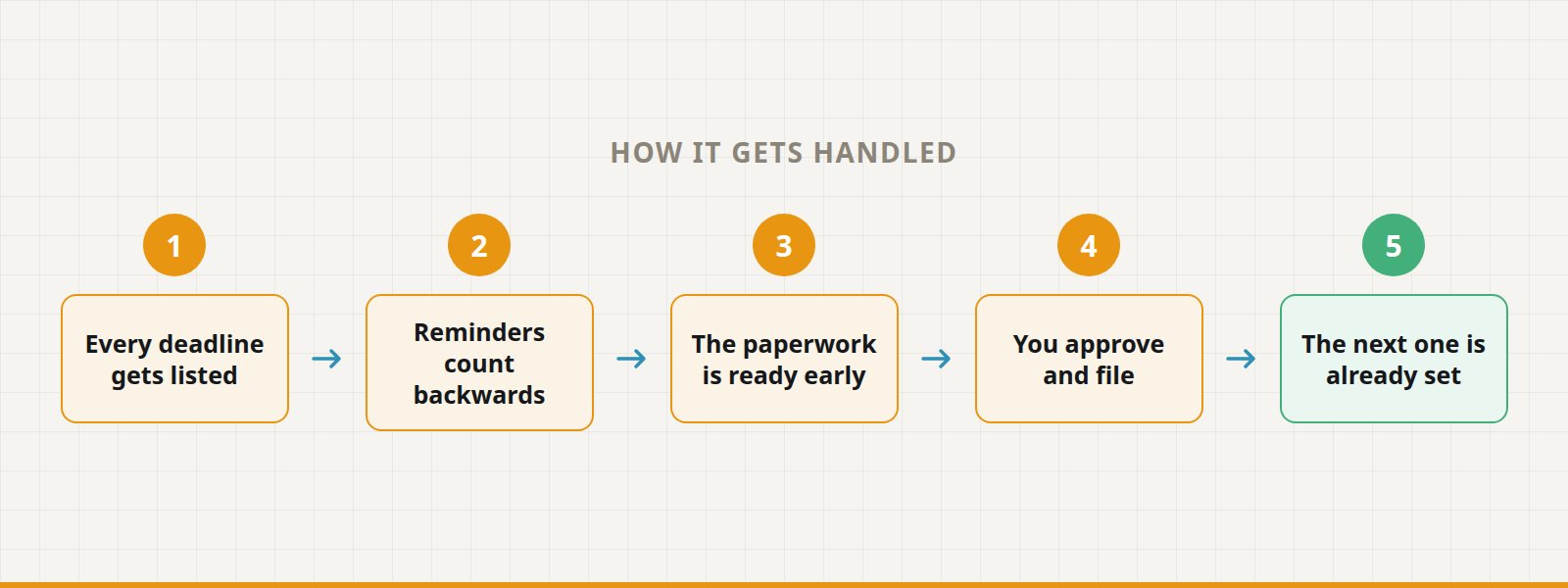
1. Every deadline gets listed. Yours specifically — the returns, the renewals, the registrations, the ones that only apply because of what you do or where you do it. Sat down and gathered once, with your accountant, in an afternoon that pays for itself the first time it catches something.
2. Reminders count backwards. Not the due date. The date the work has to start so it’s ready on the due date, which is different for a form you sign in ten minutes and a return that needs a month of records tidied first.
3. The paperwork is ready early. The figures pulled, the form filled where it can be filled, the missing piece chased from whoever has it. You arrive to something waiting, not to a task in a list.
4. You approve and file. You read it and it goes. The submission reference, the date and the copy all get kept, so proving you filed is a search rather than an archaeology project.
5. The next one is already set. The moment it’s filed, the next occurrence is on the list with its own start date. Nothing depends on someone remembering to re-enter it for next year.
The catalog calls this one the Deadline & Filing Tracker. Unglamorous, and the first thing most owners ask for once they’ve been stung.
A few versions of it:
The neighbourhood restaurant. The drinks licence and the food hygiene registration renew in windows, not on dates — too early is rejected, too late and you’re shut. The window opening is what’s tracked, not the expiry. Renewal gets dealt with in the first week it’s possible, in February, rather than in the week you’re also interviewing chefs.
The groundworks contractor. The dangerous deadlines here aren’t in any calendar, because they’re triggered by events: the notice you have to serve within a set number of days of starting on site, or you lose the protection that gets you paid. The clock starts when the job starts. Job goes in the diary, the notice deadline appears with it, and the paperwork lands before the window shuts.
The dental practice. Everything used to live in the practice manager’s head, and the practice manager left in March. Registrations, insurance renewals, each clinician’s own professional dates — all of it was one person’s memory and none of it was written down. Now it’s a list the whole practice can see, and the person who leaves takes their own knowledge with them but not yours.
Any date nobody owns behaves like this one. A lease that expired while everybody was busy is the same missed date with a rent number attached to it.
What it won’t do
This is a tracker, not an accountant. What you owe and what you must file are not its questions to answer. Whether a return is right, whether a rule applies to you this year, whether a change in your business has created an obligation you didn’t have before — that’s professional advice, and it stays that way.
It can’t know about a deadline nobody told it. There’s no master list of every obligation a business has; there’s your list. If something’s missing from the afternoon you spent building it, it stays missing, which is why that afternoon is best spent with someone who does this for a living.
Nothing gets submitted without you. Your name is on the filing and your signature is your own. It prepares, reminds and keeps the record; you press the button, and where a filing genuinely can’t be automated, it makes sure you’re sitting down to it in good time with everything to hand.
And it won’t fix records that don’t exist. If the return is late because the books aren’t done, an earlier reminder just means you find out sooner that the books aren’t done. Useful. Not the same as being ready. The bookkeeping is a separate problem and it’s the one to solve first.
Stop finding out from the overdue notice.
Operio builds and runs the AI workers that take a job like this off your desk — set up around how you actually work, watched over, and improved as it goes. You approve everything before it reaches a customer.
Or browse the full catalog of specialists to see what else can come off your plate.