
Teaching Your AI New Tricks: Custom-Training an AI on Your Core Business Values
Most AI tools sound generic because they've never seen how your business actually talks — here's what it means to coach one on your own examples, when that's worth paying for, and when a good set of instructions does the same job for free.
The assistant that sounds like everyone else
You’ve tried an AI writing tool on a few things — a customer email, a product blurb, a reply to a review. The grammar is fine. The speed is genuinely useful. But something’s off: it sounds like an assistant, not like your business. Too formal where you’d be warm. Bland where you’d have an opinion. It uses words you’d never use and skips the ones you always do.
So you end up rewriting. Not a lot — a sentence here, a tone shift there — but every single time. And that nagging thought creeps in: couldn’t it just learn how we talk?
That’s exactly the promise behind a phrase you may have heard: custom-training, or “fine-tuning,” an AI on your business. This article is about what that actually means, when it’s worth the money, and — just as often — when it isn’t.
The plain answer
Out of the box, an AI writing tool is like a sharp temp who’s worked at a thousand different companies. It knows how businesses in general sound. It has never worked at yours. So it writes to the average, and the average is exactly what feels generic.
There are two ways to fix that.
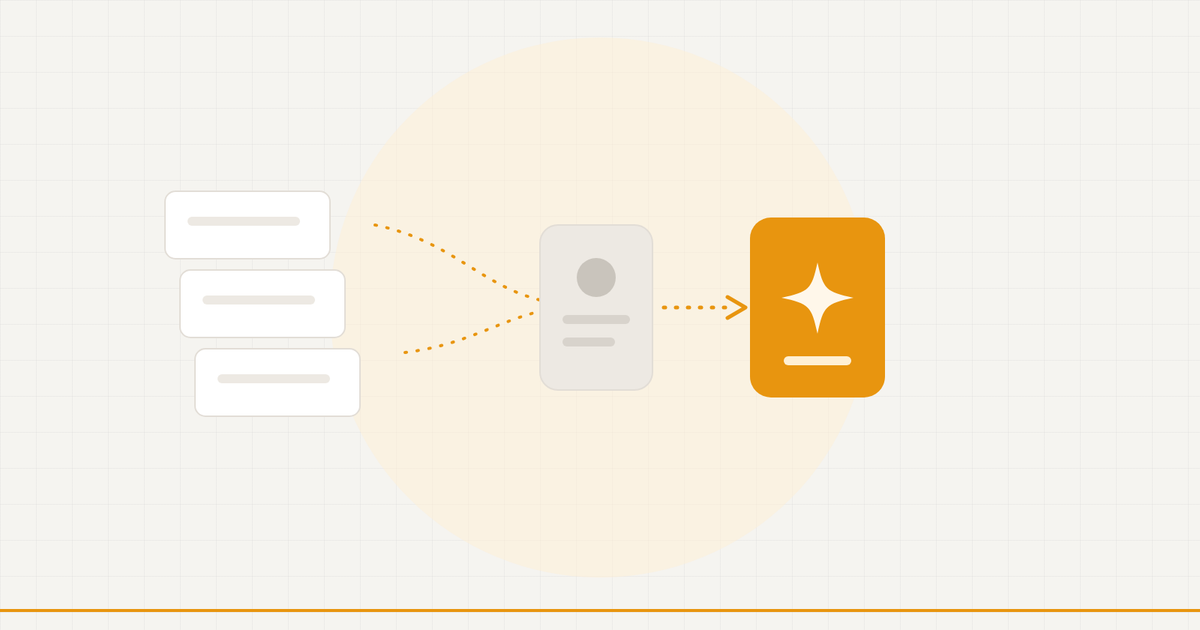
The first is to coach it in the moment. Every time you give it a task, you also hand it a few examples of how you’d do it — “here are three replies we’ve sent, match this tone” — plus a short note on your rules (“we never say ‘no problem,’ we always offer a next step”). The tool follows the examples for that job and then forgets them. It’s like briefing a temp at the start of each shift. This costs you nothing but a little setup, and for most small businesses it gets you 90% of the way there.
The second is custom-training — the thing this article is named for. Instead of re-briefing the tool every time, you sit down once with a big pile of your own real work — hundreds or thousands of examples of your business at its best — and you coach a copy of the AI on all of it until your house style becomes its default. You’re not briefing a temp anymore. You’re training a new hire until “the way we do things here” is just how they work, without being reminded.
The result is an AI that leans toward sounding like you before you’ve said a word. And because the coaching is done with a smaller, more focused version of the tool — one compact enough to run on equipment you control — your examples never have to leave your own office. That last part matters more than it sounds, and we’ll come back to it.
The honest headline, though, is this: most businesses reach for the second option when the first would have done the job. Custom-training is real and it works. It’s just rarely the first thing you need.
A concrete example
Say you run a home-services company and you answer roughly 60 quote requests a week. Each one needs a warm, specific reply in your voice — not a template, but not written from scratch either.
Try it the free way first. You write one clear instruction sheet: your tone, your do’s and don’ts, three of your best past replies as examples. You paste that in alongside each new request. The AI now drafts replies that mostly sound like you, and a person skims and sends. Suppose that trims each reply from eight minutes to three. Across 60 a week, that’s about five hours of someone’s time saved every week — call it $100 to $150 of staff time — for the price of an afternoon writing the instruction sheet once.
For a great many businesses, that’s the whole story. Stop there.
Now suppose you outgrow it. You’re up to 400 requests a week, three people are drafting, and the instruction sheet isn’t holding — the tone drifts, and pasting the same examples into every job gets tedious and inconsistent. This is where custom-training earns its keep. You gather a year of your best replies, coach a dedicated copy of the AI on all of them, and now your voice is baked in. New drafts land closer to “send” more often, every person gets the same house style automatically, and nobody has to re-brief the tool.
That project isn’t free. Realistically it’s a setup cost — some paid help to prepare the examples and do the coaching, plus somewhere to run the finished tool. It only pays back when the volume is high enough and steady enough that shaving a bit more off every draft, every day, adds up faster than the setup cost. At 60 requests a week, it won’t. At 400 with a team, it might well.
The number that decides it isn’t “how cool is this?” It’s “how many hours a week does the better version save over the free version — and does that clear what it cost to build?”
The part that’s actually about your values
The title of this piece mentions your “core business values,” and there’s a real reason custom-training connects to that — beyond just tone.
When you coach an AI on your own work, two things become genuinely yours. First, the judgment. Your best replies don’t just sound a certain way; they reflect choices — what you promise, what you won’t, how you handle a frustrated customer, where you’re generous and where you hold the line. Train on enough real examples and the tool starts to reflect those choices, not a generic company’s.
Second, the privacy. Because a custom-trained tool can be small enough to run on equipment you control, the pile of real customer work you coach it with doesn’t have to be uploaded to some outside company’s computer. It stays on your own premises — the digital equivalent of training your new hire inside your own building instead of shipping your files across town to a stranger’s office and hoping they shred them afterward. If your work involves anything sensitive — customer details, contracts, health or financial information — that’s not a nice-to-have. It’s often the whole reason to do it this way.
So “training an AI on your values” isn’t marketing fluff. At its most concrete it means two down-to-earth things: the tool inherits your actual judgment from your actual examples, and your actual examples never leave the house.
The honest caveats
It is not a fix for a fuzzy voice. Custom-training amplifies whatever you feed it. If your past work is inconsistent — three people, three tones, no agreed style — coaching the AI on it just teaches it to be inconsistent, faster. The tool can only copy a voice you already have. Getting clear on that voice is human work, and it comes first.
It doesn’t teach the AI new facts. This trains how your business sounds and decides, not what’s true today. It won’t know this morning’s prices or this week’s schedule. For that you still hand it the current facts at the moment of the task — the same “give it the real document” habit that keeps any AI tool honest. Coaching the voice and feeding it the facts are two different jobs; don’t expect one to do the other’s work.
It needs enough good examples to be worth it. A handful won’t move the needle — that’s what the free instruction-sheet approach is for. Custom-training only makes sense when you have a real, consistent body of past work and a repeated task that runs often enough to pay back the setup.
And it’s rarely the first thing to try. If you haven’t yet squeezed everything out of a good instruction sheet and a few solid examples, do that first. It’s free, it’s fast, and it tells you whether the AI is even close on your kind of work — before anyone spends real money coaching one.
The takeaway
If your AI tool sounds generic, the fix is almost always cheaper than “train our own.” Write one clear instruction sheet — your tone, your rules, three of your best examples — and hand it to the tool with every task. That alone closes most of the gap, for free.
Only when you’re running the same high-volume task, day after day, with a team, and a consistent voice you can already point to, does it make sense to coach a dedicated AI on your own examples. When it does make sense, the payoff is real: your voice and your judgment become the default, and — done on equipment you control — your files never have to leave the building.
The test is always the same one: count the hours the better version saves each week, put a dollar figure on them, and see if that clears what it cost to build. If it doesn’t, the free instruction sheet was the right answer all along.