
You haven't posted since March
Sixty jobs since your last post, and none of them exist anywhere a stranger can see. Here's how the week's work becomes posts you approve in a queue.

The last thing on your page is dated the fourth of March. It’s a photo of a finished job with the caption “Another one done 👍”. Four likes, one of them your mum.
Since March you’ve done sixty more jobs, taken somebody on, bought a second van, and fixed a roof in weather people still bring up. None of that is anywhere. As far as anyone looking can tell, your business stopped in March.
The cost of a page that says March
Doing this properly is about an hour a week. Three posts, finding the photo that isn’t blurry, writing something better than “Another one done”, putting it up at a time when a human being might be awake. Fifty hours a year, or $3,000 of your own time at $60 an hour — which is exactly why it’s the first thing dropped when a week goes sideways, and weeks mostly go sideways.
You may have tried paying somebody instead. A few hundred a month, and what came back was fine and said nothing: stock photos, a post about National Coffee Day, and a caption with an emoji you would never use. You cancelled it, correctly, and went back to March.
The cost of March isn’t likes. No business was ever saved by likes. The cost is the person who got your name on Friday from someone who rates you, looked you up on their phone that evening the way everyone now does, and found a page whose last update was five months ago. They don’t think busy. They think closed?
There’s a quieter cost too. Sixty jobs, several of them the best work you’ve done, and none of it exists anywhere a stranger can find it. The roof in the rain is a story people tell you about in the pub. It ought to be a story people tell about you.
And the guilt is its own tax. Every few weeks you decide that this is the week, spend twenty minutes scrolling your camera roll looking for something worth putting up, find eleven photos of a boiler and one of a skip, and close the app. That’s not a plan failing. That’s the same plan failing on a schedule, which is a good deal more tiring.
How it gets handled
The raw material already exists. You take photos of finished work because you’re proud of them. What’s missing is the hour on a Wednesday, and the hour is never coming.
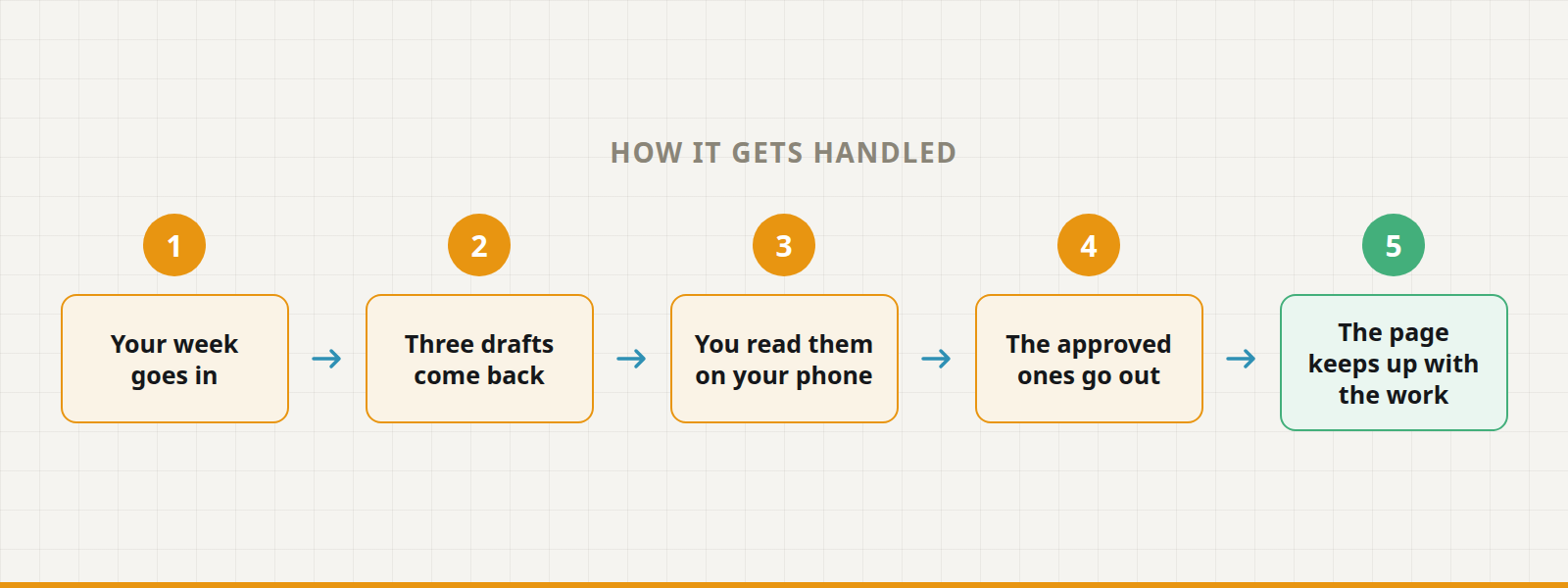
Here’s the order it actually happens in.
1. Your week goes in. Three photos off your phone and a sentence of context: what it was, roughly where, what was awkward about it. Thirty seconds, standing at the van, one-handed.
2. Three drafts come back. In your words, at your length, about the job you actually did. Not “we are thrilled to announce”. The one about the awkward part is usually the good one.
3. You read them on your phone. In the queue at the merchants. Change a word, bin one, tick the other two.
4. The approved ones go out. Spaced across the week at hours people are actually looking, to the two places you use rather than the seven you signed up for in 2019.
5. The page keeps up with the work. Somebody looking you up in November sees November.
It doesn’t have opinions about your business. It has your photos, your one sentence and the way you talk, and it turns those into something you can approve in the time it takes to pay for timber. In the catalog this one is the Content Drafter.
A few versions of it:
The personal training studio. In January you post four times a week, because January is quiet enough to allow it. By March you’re full and the posting stops — which is precisely when the people who joined in January are deciding whether to keep paying you. The drafts carry on through March, built out of photos you were taking anyway, so the quiet months aren’t the only months where you look alive.
The garden centre. The bare-root roses are in for a fortnight and then the moment has gone. Nobody in the shop has a spare hour during the fortnight it matters, because that fortnight is when everyone is on the tills. A photo taken on the Tuesday morning is three posts by Tuesday teatime, out while the plants are still on the bench and the weather still suits them.
The accountancy practice. You have more genuinely useful things to say than almost anyone and you post none of them, because everything you write has to be right, and right has a specific meaning in your world. The drafts come back with the caveats already in and nothing that reads as advice to an individual. Your review is the same review you’d have done anyway. The difference is that there’s finally something to review.
The raw material is your own week, which you’d have to be watching in order to write about. Yesterday on one page, before the first van moves is the same habit pointed inward.
What it won’t do
It doesn’t know what happened this week unless you tell it. The photo and the one line are yours, and there’s no way round that — send nothing and you get nothing. Thirty seconds a week is the actual price, and it’s the reason this stalls for the owners it stalls for.
Nothing goes out without your say-so at the start. Every draft waits in a queue until you tick it. Some owners eventually let the plain ones — a finished job, an opening hours change — go on their own and keep approval on anything with an opinion in it. Where that line sits is yours.
It can’t make the work more interesting than it was. An ordinary fortnight makes ordinary posts. It writes about what actually happened, not what you wish had happened, and it won’t put words in your mouth to fill a Thursday.
And it won’t fill your diary. Posting isn’t a sales channel on its own; it’s what people find when they check whether you’re real and still trading. Judge it as a lead source and you’ll be disappointed. Judge it as the difference between looking active and looking gone, and it earns its hour back several times over.
Stop letting your page say March.
Operio builds and runs the AI workers that take a job like this off your desk — set up around how you actually work, watched over, and improved as it goes. You approve everything before it reaches a customer.
Or browse the full catalog of specialists to see what else can come off your plate.