
That one-star review has been sitting there nine days
An unanswered complaint reads like an agreed one. Here's how every review gets a calm reply the same day, in your words, with you approving it first.

“Booked three weeks ahead. Turned up. They had no record of it. No apology, nothing.”
One star. Nine days ago. Underneath it, in grey, the word Owner and an empty space where a reply would go.
You’ve read it eleven times. You wrote an answer on the second night at half past eleven and didn’t send it, which was the correct decision, because it opened with the word “Actually”.
What nine days of silence costs
There’s no clean hours-and-dollars sum here and it would be daft to pretend otherwise. A good reply takes twenty minutes: five for writing it, fifteen for not sending the first version. Say two a month need real thought, plus a dozen kind ones a year that deserve better than “Thanks!”. That’s under an hour a month. Call it $50 of your time at $60 an hour, and $50 is plainly not the reason this doesn’t get done.
It doesn’t get done because it’s the only admin on your desk that can make things worse. Everything else is roughly neutral if you get it slightly wrong. This one is published, permanent, and read by people deciding whether to give you money.
So the cost isn’t the hour. It’s the nine days, and everyone who read it during them.
You’ve done this yourself. Stood in a car park with your phone, looked a place up, gone straight past the good reviews to the worst one, and made your decision right there. An unanswered complaint reads like an agreed one. The same complaint with a level reply underneath it reads like a bad day at a place that cares. Same review, different business.
And then the good ones. Someone spent four minutes on a Sunday writing that your team were lovely and that they’d send their sister. It’s been sitting there since June with nothing underneath it.
How it gets handled
The aim isn’t more reviews. It’s that none of them go unanswered, and that the answer goes up while it still counts.
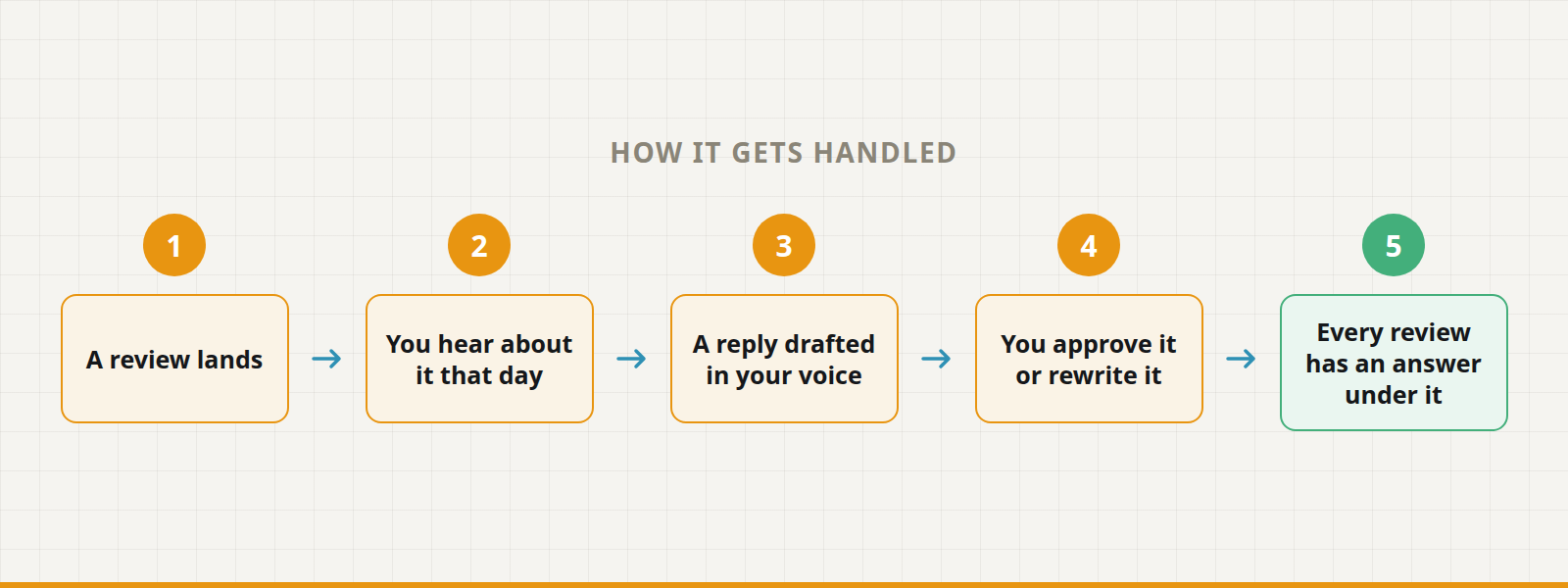
Here’s the order it actually happens in.
1. A review lands. Google, Facebook, the booking site, the trade directory — wherever yours actually turn up.
2. You hear about it that day. One message, with the review in it and the stars, instead of finding out three weeks later because a customer mentioned it.
3. A reply drafted in your voice. Written before you’ve even opened it: the specifics named, the wait or the mix-up acknowledged, no arguing, no “we take all feedback seriously”, and where it belongs, an offer to move it to a phone call.
4. You approve it or rewrite it. Change a word, cut a line, or throw the whole thing out and write your own. It goes up when you say and not before.
5. Every review has an answer under it. Including the four and five-star ones, which is the bit everybody skips and the cheapest goodwill on the internet.
In the catalog this one is the Review Responder. Its real qualification is that it has never once been kept awake by a stranger’s opinion, and can therefore write about it at nine in the morning rather than at half eleven at night.
A few versions of it:
The café. Sunday was a mess: one person off, forty covers, and a table waited fifty minutes for two breakfasts. The review is accurate, which is the worst kind. Monday’s reply names the wait, doesn’t explain the staffing (nobody cares about the staffing), and says come back and breakfast’s on us. Some of them do come back. Everyone else reads a business that didn’t argue.
The car garage. The review says you charged for work that wasn’t done. It isn’t true, and you have the job sheet that shows it. The reply isn’t written for the person who left it — it’s for the next person reading. Two sentences: what was quoted, what was authorised, and an invitation to bring the paperwork in. No sarcasm, no capital letters. It stayed that calm because it was written on the day, not on the fourth reading.
The holiday cottage. Three stars, and the complaint is the church bells. You did not build the church. The reply thanks them, agrees the six o’clock one is a shock the first morning, and mentions that it’s now in the listing — which turns a middling review into a note for the next guest, and quietly stops it happening again.
Most bad reviews start life as a message nobody answered. The 2 a.m. “how do I get in?” is where a lot of three-star mornings begin.
What it won’t do
It doesn’t decide whether you’re sorry. Apologise, or hold your ground and say what actually happened? That’s a judgement about your own business and getting it wrong in public is expensive. It will draft you both versions. Choosing is yours, every time.
Nothing gets posted without your say-so. Especially here. Plenty of owners hold approval on every single reply forever and never move that line at all, which is a perfectly sensible place to leave it.
It won’t get a review taken down. If it breaks the site’s rules you can report it, and that sometimes works, slowly. If it’s simply unkind, or true and badly timed, it stays up. The reply underneath is the only lever you have, which is exactly why it matters that there is one.
And it can’t fix the thing the review is about. Six calm, well-written answers about the same fifty-minute wait is a well-written record of a problem you still have. The replies buy you the benefit of the doubt. They don’t buy you a second chef.
Stop leaving that one sitting there.
Operio builds and runs the AI workers that take a job like this off your desk — set up around how you actually work, watched over, and improved as it goes. You approve everything before it reaches a customer.
Or browse the full catalog of specialists to see what else can come off your plate.