
"Where's my order?" — asked thirty times today
Thirty perfectly reasonable questions a day, each one costing ninety seconds and your place in whatever you were doing. Here's how they get answered.
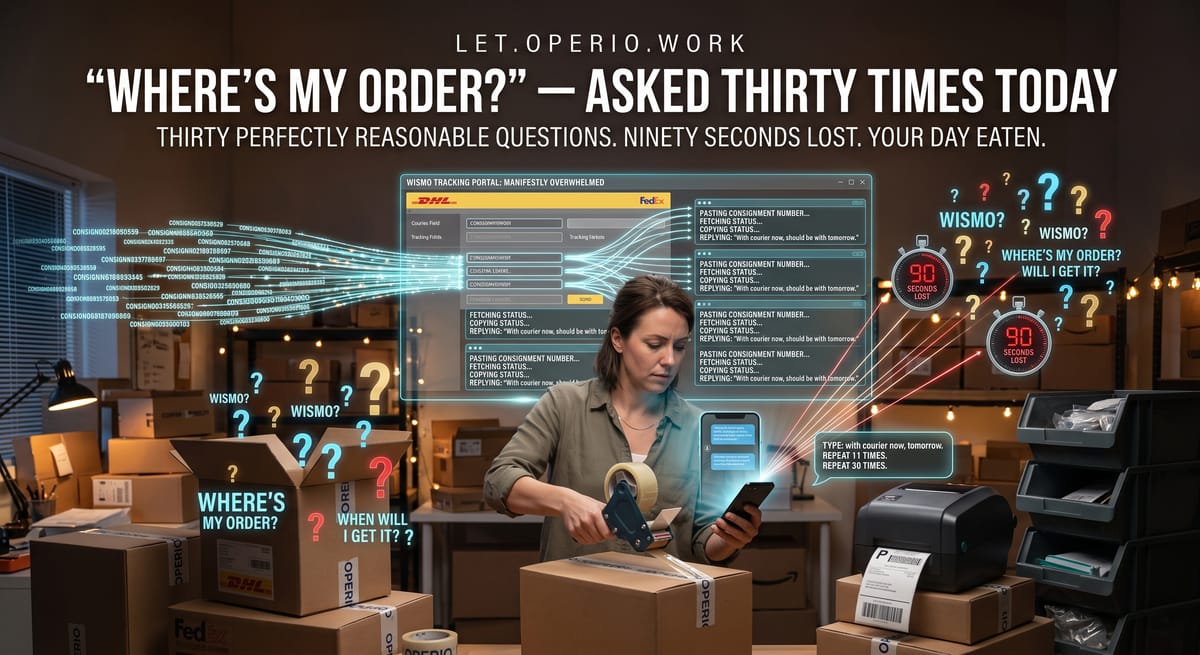
There’s a tab open on your phone that has been open since Monday. It’s the courier’s tracking page. Today you have pasted eleven consignment numbers into it, copied eleven lines of status back out, and typed some version of the same sentence eleven times: that’s with the courier now, should be with you tomorrow.
The twelfth arrives while you’re taping a box shut.
It is a perfectly reasonable question. Every one of them is a perfectly reasonable question, asked by somebody who has paid you and would quite like their thing. That’s what makes it impossible to be annoyed about, and it’s exactly why it eats the day.
What a reasonable question costs thirty times a day
Take thirty a day — not a bad week, just an ordinary Tuesday in the run-up to Christmas. Each one is: work out who they are, because the name on the message isn’t always the name on the order. Find the order. Find the consignment number. Check whether the parcel has genuinely moved or just been labelled. Write something back that sounds like a person rather than a status field.
Ninety seconds when nothing goes wrong. Thirty a day, six days, and you’re at four and a half hours a week — about $270 of your own time at $60 an hour, spent reading a courier’s website out loud.
Except it’s never four and a half clean hours, and that’s the part that doesn’t show up in the arithmetic. It’s a hundred and eighty interruptions. You’re mid-pick with a list in your hand, the phone goes, and when you come back you check the same shelf twice because you can’t remember whether you already did. The messages cost ninety seconds. The stopping costs more, and it’s spread so thinly across the day that you can’t point at it.
There’s a slower cost as well. Someone who asks once is curious. Someone who asks twice is worried. Someone who asks three times and gets nothing writes a review about communication rather than about the thing they bought, and that review outlives the order by about two years.
And underneath all of it, the one that actually matters: somewhere in those thirty is a parcel that hasn’t scanned since Tuesday. You would very much like to know about it before the customer does.
How it gets handled
Nothing here replaces your shop, your shipping software or your courier. The orders stay where they are. What changes is who does the looking up.
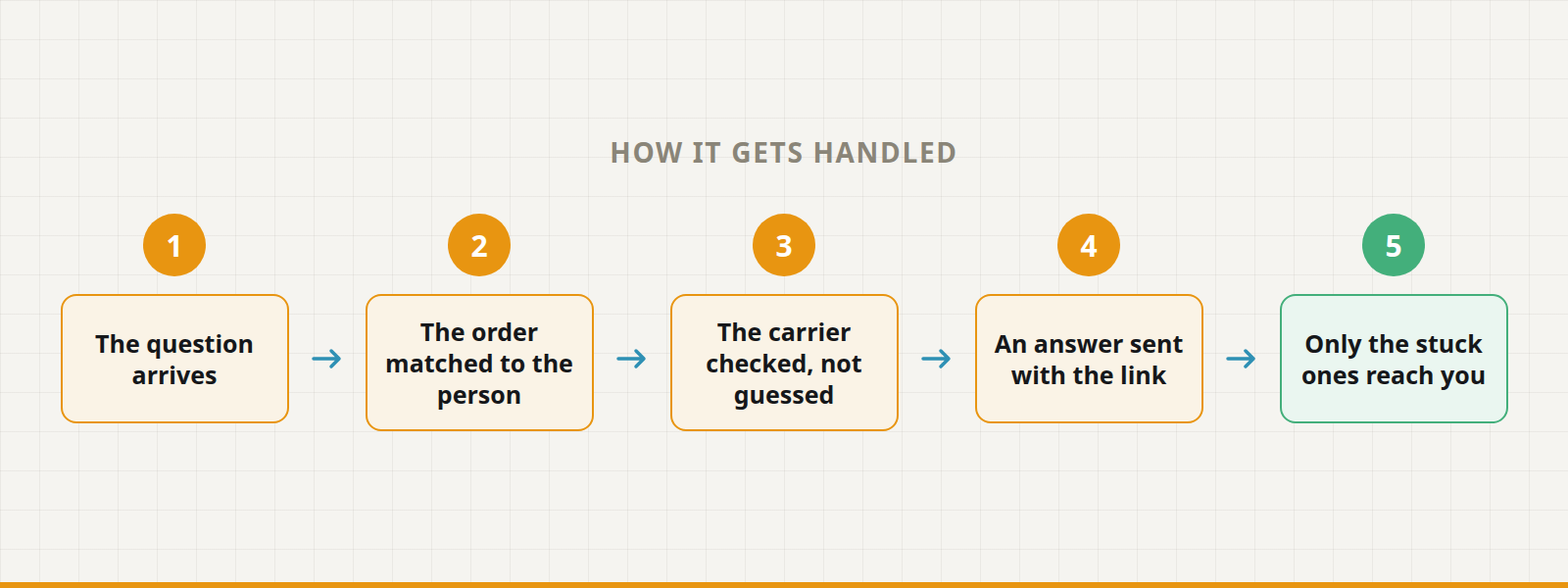
Here’s the order it actually happens in.
1. The question arrives. Email, Instagram, WhatsApp, the form on the site. Half of these arrive as three words and a first name, which is the whole problem with them.
2. The order matched to the person. By order number if they gave one, and by the email, the name, or the last thing they bought if they didn’t. If it can’t be matched with confidence, it doesn’t guess — it asks them one short question.
3. The carrier checked, not guessed. The actual scan, as it stands right now. Not the date on the dispatch note, not what usually happens with that service.
4. An answer sent with the link. Where it is, when it’s due, and the tracking link, in a sentence that sounds like your shop. If it’s late, it says so, because they can already see that it’s late.
5. Only the stuck ones reach you. No scan in three days. Marked delivered by someone who hasn’t got it. Damaged in transit. Those come to you with the history attached, and they’re the only ones you have to think about.
In the catalog this is the Order Support Agent, and its actual job title should probably be reads the tracking page so you don’t have to.
A few versions of it:
The candle maker. Nothing ships the day it’s ordered because nothing exists the day it’s ordered — you pour on Tuesdays and post on Fridays. So the honest answer isn’t a tracking number at all, it’s yours is in Thursday’s batch, out on Friday, which has to come from the production board rather than the courier. People are remarkably relaxed about waiting when somebody tells them what they’re waiting for.
The tile and stone supplier. The special order is coming from a mill in another country and the date belongs to a supplier who updates you by email on a Monday, if you’re lucky. What goes back to the customer is the supplier’s own date, when it last changed, and what you’ll do if it slips again — the trade counter version of showing your working, which builders respect far more than optimism.
The print shop. A good share of where’s my order turns out to be we’re waiting on you to approve the proof. That’s an awkward thing to say thirty times a week without sounding like you’re blaming somebody. It’s not awkward at all when it goes out politely, with the proof attached and a button to approve it, forty-eight hours after it was sent.
The same idea works on questions that have nothing to do with orders. When the answer is somewhere in two hundred of your own files, it can be found and quoted rather than remembered.
What it won’t do
It can’t invent a date the courier hasn’t given it. If a parcel hasn’t scanned since Tuesday, the answer is that it hasn’t scanned since Tuesday and here’s what’s being done about it. That’s a worse message to send than a comforting guess, and it’s the only one worth sending — a guess that turns out wrong costs you the customer twice.
It doesn’t decide the refund. Replace it, resend it, refund it, send it again with something extra in the box because they’ve been patient: that’s a judgement about a person, and it stays yours. What you get is the case in front of you early enough to make it calmly.
Nothing goes to a customer without your say-so at the start. You approve the wording while it settles in, and later you can let the plain here’s your tracking replies go on their own and keep every awkward one for yourself.
And it can’t fix fulfilment. If thirty people a day ask where their order is because orders genuinely take three weeks and the website implies five days, then answering faster only delivers the bad news sooner. Sometimes the message telling you that is worth more than the time you saved.
Stop answering the same question thirty times a day.
Operio builds and runs the AI workers that take a job like this off your desk — set up around how you actually work, watched over, and improved as it goes. You approve everything before it reaches a customer.
Or browse the full catalog of specialists to see what else can come off your plate.