
The boiler died at eleven at night and the tenant called you
You are not a heating engineer and it is eleven at night. Here's how the after-hours call gets answered, sorted, and handed to you only when it's yours.

“It’s making a noise. Like a knocking, and then it stops.”
It’s 11:04 on a Tuesday. You are in bed. You have been asked, very politely, to diagnose a boiler over the phone by someone standing in a cold flat who would like a hot shower in the morning.
You say you’ll sort it. You have no idea who you are going to ring at 11:04 at night. You say it anyway, because the alternative is saying nothing, and they have been good tenants.
Then you lie there thinking about it until one.
What eleven at night actually costs
Count last month’s, and count all of them — not just the emergencies. The knocking boiler, the neighbour’s music, the key that turned funny in the lock, the sorry to bother you but has the bin day changed this week.
Say six calls outside working hours. Ten minutes on the phone each, then twenty minutes afterwards working out what on earth to do about it and whether it can wait until morning. That’s three hours a month, about $180 of your own time at $60 an hour, spent mostly on the ones that could have waited until Tuesday.
The $180 is the cheap part. The expensive part is the decision you make at 11:04 with almost no information: send someone now, or gamble that it holds. Get that wrong in one direction and you pay the out-of-hours rate for something the reset button would have fixed, and you have seen the difference between a weekday invoice and a midnight one on your own paperwork. Get it wrong in the other direction and a slow leak becomes a ceiling.
Then there’s the part nobody bills you for. Your phone is a work phone now, permanently, including on holiday, including at your mother’s birthday. The tenants aren’t being unreasonable — you are the only number they have. But the number is you, and it is always you, and after a while you start reading every unfamiliar call as bad news.
How it gets handled
The point isn’t to stop tenants ringing. It’s that most of what they ring about doesn’t need you. It needs an answer, a question or two back, and someone to write it down properly.
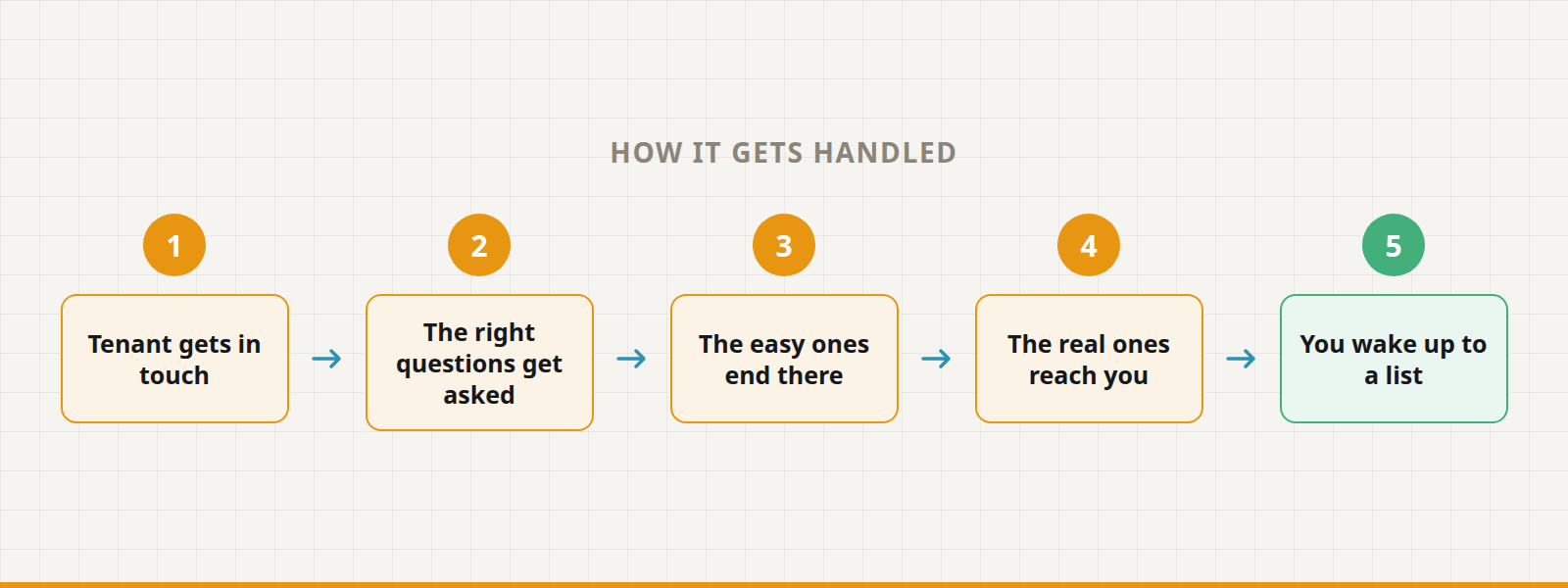
Here’s the order it actually happens in.
1. Tenant gets in touch. The number they already have, the way they already use it — a call, a text, the form on your site. Nothing changes at their end and nobody has to install anything.
2. The right questions get asked. Is there water coming through anywhere. Is it getting worse or has it stopped. Can you smell gas. Which room, and can you send a photo. They’re the questions you’d ask, because you wrote them down once — and a photo of a boiler display at eleven at night is worth about four minutes of phone call.
3. The easy ones end there. Where the stopcock is. How to reset the boiler. How to bleed a radiator. What to do about a smoke alarm that’s chirping. Bin day. Answered from what you’ve written down, at 11:04, and you meet them in the morning as one line on a list.
4. The real ones reach you. Water through a ceiling, no heat in December, anything involving gas, anyone shut out of their own home. Your phone rings, and it rings with the address, the tenant’s name, and a sentence saying what is happening — not “call me back”.
5. You wake up to a list. Four things happened overnight. Three are closed. One is the boiler in Flat 2, and the tenant has already been told that someone is coming and roughly when.
The catalog calls this one the Tenant Liaison. It is awake at 11:04 and it doesn’t mind being asked about the bins.
A few versions of it:
The accidental landlord. One flat — your old flat, the one you couldn’t quite bring yourself to sell. You have a full-time job, and you are also the entire property management company. The Tuesday-night lockout gets the locksmith you actually use, plus a text telling you it happened, which you read at seven with a coffee instead of standing in a hallway at midnight being no help to anyone.
The letting agency after six. You already pay for an out-of-hours service and what it does is take messages. Monday is forty of them and no idea which three matter, so somebody’s first hour of the week goes on voicemail. Now they arrive sorted, the routine ones already answered and closed, and Monday starts with the four that are still open.
The student house. Six tenants, one boiler. When it goes, five of them report it and every report is slightly different. They land as one thing rather than six — and the message that mentions water on the kitchen floor is the one that reaches you first, because that detail is the whole difference between Thursday and tonight.
By morning it’s a list rather than a pile, which is the other half of this problem — four hundred unread, and the one that mattered on page three.
What it won’t do
It can’t tell an emergency from a nuisance on its own. You draw that line once, in writing: this wakes me, this waits until eight, this waits until Monday. It holds that line exactly, which is the point — but the line is yours, and the first month will throw up two or three cases you hadn’t thought of. You add them. It takes ten minutes.
Nothing goes to a tenant without your say-so at the start. You read every reply for the first fortnight and change the ones that don’t sound like you. Then the settled answers — stopcock, reset, bin day — go on their own, and everything else still waits for you.
It can’t fix the boiler. Somebody still drives out with a bag of tools, and finding that somebody quickly is a separate problem with its own separate headache. What changes here is the twenty minutes between the call and a decision, and whether the tenant hears the truth at 11:05 instead of guessing until Wednesday.
And it can’t fix a property that keeps breaking. If one flat generates a call a fortnight, the honest answer is a new boiler, not a faster answering service. You’ll see that pattern very clearly once every call is written down in the same place, and you may not enjoy it.
Stop being the emergency number.
Operio builds and runs the AI workers that take a job like this off your desk — set up around how you actually work, watched over, and improved as it goes. You approve everything before it reaches a customer.
Or browse the full catalog of specialists to see what else can come off your plate.