
Four hundred unread, and the one that mattered was on page three
You're not disorganised. Four hundred emails arrived. Here's how the pile gets sorted before you open it, so the message that matters is the one on top.

The message that actually mattered arrived Tuesday at 9:40 in the morning. You found it Thursday.
By then it was on page three, under a delivery notification, two newsletters you don’t remember subscribing to, a supplier statement, and eleven replies to a thread that was settled a week ago. Somewhere in that pile a customer who was ready to spend money asked you a simple question, heard nothing back, and asked somebody else.
You are not disorganised. You have four hundred unread emails because four hundred emails arrived.
What the pile actually costs
Forty messages land on a normal day, and the sorting starts before the answering does. Fifteen seconds each just working out what the thing is — open, skim, decide, close, or leave it bold and feel slightly worse about it. That’s ten minutes of pure sorting before you have answered anything at all.
Then the answers. Say fifteen of the forty need a real reply, and most of those replies you have written before: your hours, your rates, where to park, the lead time, whether you cover that postcode. Two minutes each is half an hour. Add the sorting and a normal week costs you a bit over three hours — around $200 of your own time at $60 an hour — on a job where your actual judgement was needed for maybe six of those messages.
But the three hours aren’t the real bill. The real bill is Tuesday at 9:40.
You’ll never know what that one was worth, which is its own particular kind of annoying. And the pile does something else to you: it turns your phone into a thing you check at half past ten at night, because the only way to feel on top of it is to never quite put it down. Everyone talks about inbox zero. Nobody who runs a business has ever seen it.
How it gets handled
Nothing here asks you to move your email somewhere new or adopt a system with a name. The mail arrives where it arrives. What changes is that it has been read and put in order before you get there.
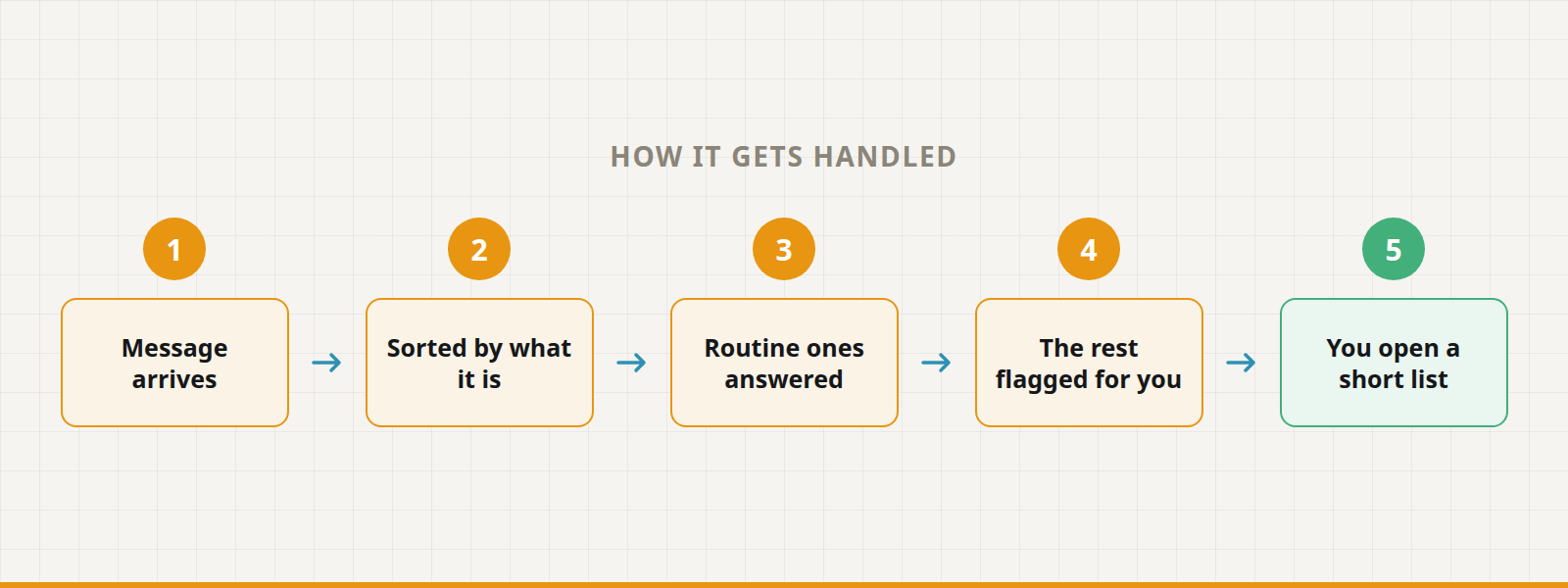
Here’s the order it actually happens in.
1. Message arrives. Email, the website form, WhatsApp, whichever ones you actually use. It lands in the same inbox it lands in today. Nothing gets migrated.
2. Sorted by what it is. A booking request. A supplier invoice. A “where’s my order”. A complaint. A newsletter. Someone asking your opening hours. The categories are yours — you name them once, in your own words, from the things that genuinely turn up.
3. Routine ones answered. The questions with a settled answer get one: hours, rates, parking, lead times, the areas you cover. Drawn from what you’ve written down, in the tone you use. When the answer isn’t in there, it says so and hands the message to you instead of guessing at it.
4. The rest flagged for you. Anything with a decision inside it, anything from someone who matters, anything that reads angry or urgent — those come to the top, with one line saying what’s being asked and what’s already been said to them.
5. You open a short list. Six things instead of four hundred. And the Tuesday 9:40 message is at the top of it, on Tuesday.
The catalog calls this one Inbox Triage: reads everything, surfaces what matters. It is a fair description of a job nobody wants and every business needs.
A few versions of it:
The plumber. You’re under a sink from eight until six with the phone in your other pocket. Fourteen emails arrive while you’re down there. Two are jobs, one is a supplier saying the part is delayed, the rest can wait until Sunday. The two jobs get a “yes, I can look at that — which days work for you?” within the hour, which is frequently the entire reason you get the job. The delayed part is on your list before you’re out from under the sink.
The letting agent. Tenants, landlords, contractors, and the occasional person asking whether the flat with the bay window is still going. Repair requests arrive already tagged with the unit and the address. The landlord asking about their statement gets their statement. And the one message containing the word leak is not sitting behind eleven others about parking.
The online shop. Thirty versions of “where’s my order” a day, every one of them perfectly reasonable, every one costing two minutes and your place in whatever you were doing. Those get the tracking link. What reaches your list is the one saying the parcel arrived broken — a real conversation, and now you have the time to have it properly.
One thing a sorted list keeps surfacing is the email you keep not writing — the invoice that’s forty days late and still hasn’t been chased.
What it won’t do
It doesn’t know what matters to you on day one. It learns the shape of your inbox from the rules you set and the corrections you make in the first fortnight. Expect to drag a few things back where they belong. That’s the setup, not a fault, and it’s most of the work.
Nothing reaches a customer without your say-so at the start. Every drafted reply waits for you until you’re happy with how it sounds. Later you can let the settled answers go out on their own and keep approval on everything else. You decide where that line goes, and you can move it back any time you like.
It won’t answer what you’ve never written down. The rates that live in your head, the policy you decided in March and told nobody: it can’t reach those, and it won’t invent them. It marks them for you and moves on. (Honestly, half the value of setting this up is the afternoon you finally spend writing that down.)
And it won’t fix an inbox that’s full because something upstream is broken. If forty people a week write to ask a question your website should be answering on the front page, faster replies are a bandage. Sorting the mail is not the same as fixing the reason there’s so much of it.
Stop reading four hundred emails to find six.
Operio builds and runs the AI workers that take a job like this off your desk — set up around how you actually work, watched over, and improved as it goes. You approve everything before it reaches a customer.
Or browse the full catalog of specialists to see what else can come off your plate.