
"Is there gluten in the sauce?" — and you're mid-service
The gluten question lands in the busiest four minutes of the evening. Here's how it gets a straight answer from today's menu, without anyone leaving the pass.

“Table nine wants to know if there’s gluten in the sauce.”
It’s twenty past eight. Six tickets on the rail, two of them for the same table, and the person asking you started three weeks ago. The honest answer is that the sauce is fine — probably — except the stock came in a different tub on Tuesday and nobody has read the back of it yet.
You wipe your hands. You go and read the tub.
Table nine waits four minutes for something that should take ten seconds, and everything behind you on the rail moves four minutes further into the evening.
What stopping to check actually costs
Count a Friday. Six of these in a service is a quiet night: two at the table, one on the phone, one through the booking form, two at the door before anybody sits down. Some are a straight answer. Some are the tub.
Four minutes each, once you include the walking and the reading and getting back into the rhythm you were in, is around twenty-five minutes. Twenty-five minutes taken out of the only two hours in the week where nothing can be taken out. If you’re the owner and your hour is worth $60, the arithmetic says $25 — which understates it, because those particular minutes cost more than the average ones. Ask anyone who has tried to plate four mains while holding a jar.
Then there are the ones you never see. The table of eight that rang on Wednesday because one of them is coeliac and one can’t have nuts, got a “I’ll check with the chef and call you back”, and heard nothing. They ate somewhere else on Friday. You will never know that happened, which is the annoying part.
And the part nobody says out loud: getting this wrong isn’t a bad review. It’s an ambulance. So everyone checks, every time, and they’re right to. The checking is not the problem. The problem is that the checking happens in the worst four minutes of the day, out of a folder that was printed before the menu changed.
How it gets handled
Nothing here asks the kitchen to work differently. Same menu, same suppliers, same four o’clock decision about what the special is. What changes is that the answer stops living in one person’s head and a folder by the till.
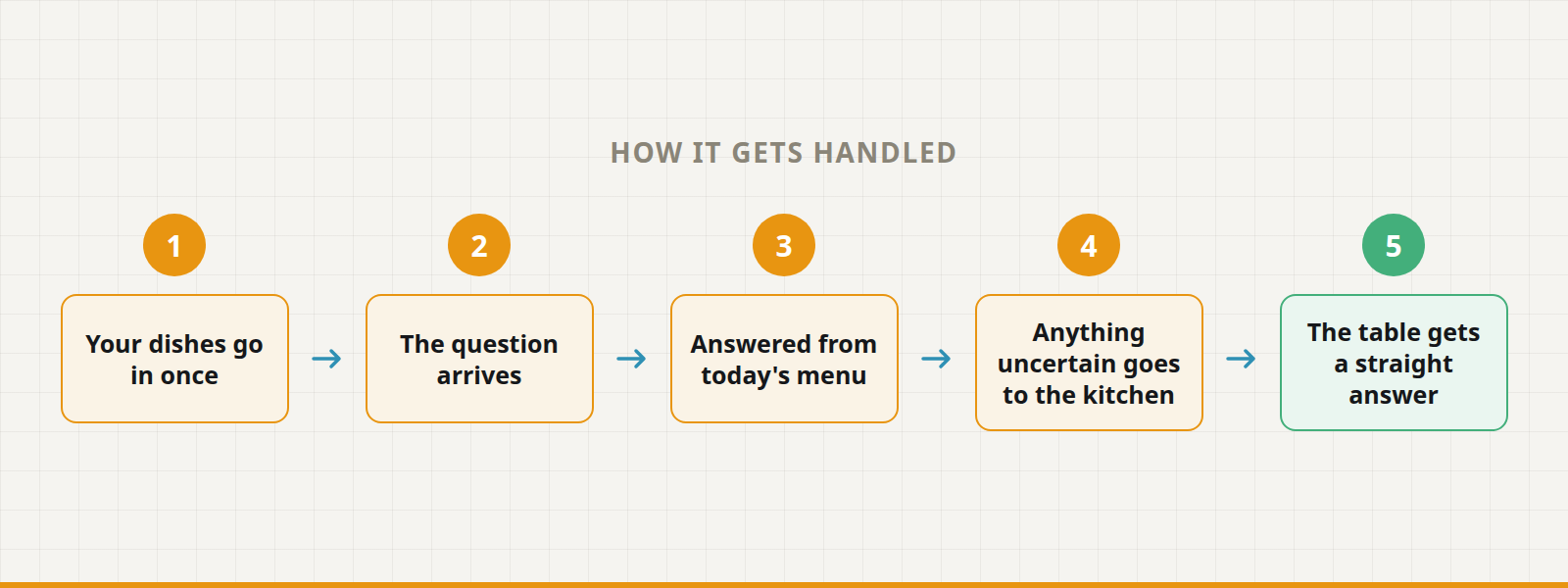
Here’s the order it actually happens in.
1. Your dishes go in once. Every dish, every sauce, every dressing, with what’s in it — taken from the spec sheets and supplier labels you already have in a drawer. It’s an afternoon’s work, and it’s the only slow part.
2. The question arrives. From the table, from the phone, from the booking form, from a message at eleven at night asking whether the children’s menu has anything for a dairy allergy. Same question, four doors.
3. Answered from today’s menu. Today’s — including the special that got decided at four, and the sauce that changed when the supplier changed. The answer names the dish, says what’s in it, and says what can be left out.
4. Anything uncertain goes to the kitchen. A dish edited an hour ago, a substitution nobody wrote down, a question about how the fryer is shared: it doesn’t guess at any of those. It stops and asks the pass. One line, not a conversation.
5. The table gets a straight answer. Inside a minute, off the server’s own screen, in the words the kitchen would have used.
In the catalog this one is the Menu & Allergy Concierge, which is a grand name for something that mostly just remembers what’s in the dressing. It has read every label you gave it, and it reads them the same way at nine on a Saturday as it does at eleven on a Tuesday.
A few versions of it:
The gastropub with a specials board. Six dishes change on Thursday and the printed allergy folder is still on last month’s menu. The folder gets updated when somebody remembers — a phrase that ought to worry you. Here the specials go in when they’re written up on the board, and the answer at the table is about the food actually on the plate.
The bakery counter on a Saturday. The question isn’t difficult. It’s whether there are nuts in the traybake. It’s difficult because the person who knows is off until Monday and there are nine people in the queue. The Saturday hire gives the same answer the owner would, without holding up the till or ringing anyone at home.
The hotel with a wedding in three weeks. The coordinator emails a list: two coeliacs, a severe shellfish allergy, a vegan, and a child who can’t have egg. That needs a written answer, dish by dish, that someone will hold you to on the day. It gets drafted in ten minutes instead of sitting in the inbox until the head chef’s next day off.
Any question asked thirty times a day is really one question with thirty askers. The “where’s my order” version gets handled off the same idea.
What it won’t do
It doesn’t make the call on cross-contamination. Whether you can safely serve a severe allergy out of a kitchen with one fryer and one board on a full Friday is a judgement about your room, your staff and that particular night. It gives the facts and flags the risk. The person standing at the pass decides.
Nothing reaches a guest without your say-so at the start. You read the answers before they go anywhere, and you’ll want to — that’s how the wording ends up sounding like your kitchen rather than a label. Most places keep approval on anything allergy-related permanently and let the “do you have a vegan main” questions go out on their own. Where that line sits is yours to set and yours to move.
It’s only as right as what you put in. Change the stock, change the bread, use up the last of the old dressing and make a new one — if nobody changes the line, it will answer from the old one, and it will sound just as certain doing it. That’s a two-minute job on delivery day, and it is the whole reliability of the thing.
And it won’t fix a menu nobody can describe. If the answer to “what’s in the house dressing” is “ask Marco”, writing that down is going to be an uncomfortable afternoon. Have it anyway. That’s a kitchen conversation, not a software one.
Stop leaving table nine waiting.
Operio builds and runs the AI workers that take a job like this off your desk — set up around how you actually work, watched over, and improved as it goes. You approve everything before it reaches a customer.
Or browse the full catalog of specialists to see what else can come off your plate.