
Six emails to book one appointment
Agreeing on a time takes six messages and four days, and some of them never land at all. Here's how the appointment gets into the diary without the rally.

“Would Thursday work?”
“Thursday’s tricky. Could we do Friday morning?”
“Friday morning I’m out at a job. Friday after two?”
“I finish at one on Fridays. Monday?”
It is now the Wednesday of the following week and the appointment still isn’t in the diary. Six messages, four days, two people who want precisely the same thing and neither of whom can see the other’s calendar. Somewhere in the middle of it you wrote let me check and come back to you, which you meant at the time.
What the rally actually costs
You send more of these than you’d guess. Say eight appointments get booked, and the average one takes five or six messages to pin down. That’s around forty-five messages that exist for no reason except agreeing on a time.
Two minutes each is generous, until you remember what those two minutes contain: reading it, opening the calendar, working out whether Thursday is genuinely free or only looks free because you haven’t written the Tuesday job in yet, then composing a sentence that offers something without promising too much. Call it an hour and a half a week. At $60 an hour that’s about $90 spent every week deciding when to meet, before anybody has met.
The ninety minutes isn’t the expensive part. The expensive part is the rallies that never finish. Of eight enquiries, one or two go quiet somewhere around message four — not because they went to a competitor, and not because they changed their mind, but because agreeing on a time turned into a small chore and neither of you moved it along. You never find out. It just sits in the sent folder looking like it’s still alive.
And then there’s the diary itself, which is technically yours and which you don’t fully trust. You keep a second version of it in your head — the Friday you half-promised, the job that will definitely overrun, the appointment you offered on Monday and haven’t heard back about and can’t quite give away yet. Holding that is a low, constant hum, and it’s the reason you check the calendar before answering anything.
How it gets handled
You don’t move to a new calendar and you don’t send people a booking link with your whole week laid bare on it. The calendar you already keep stays where it is. What changes is that the back-and-forth happens without you in it.
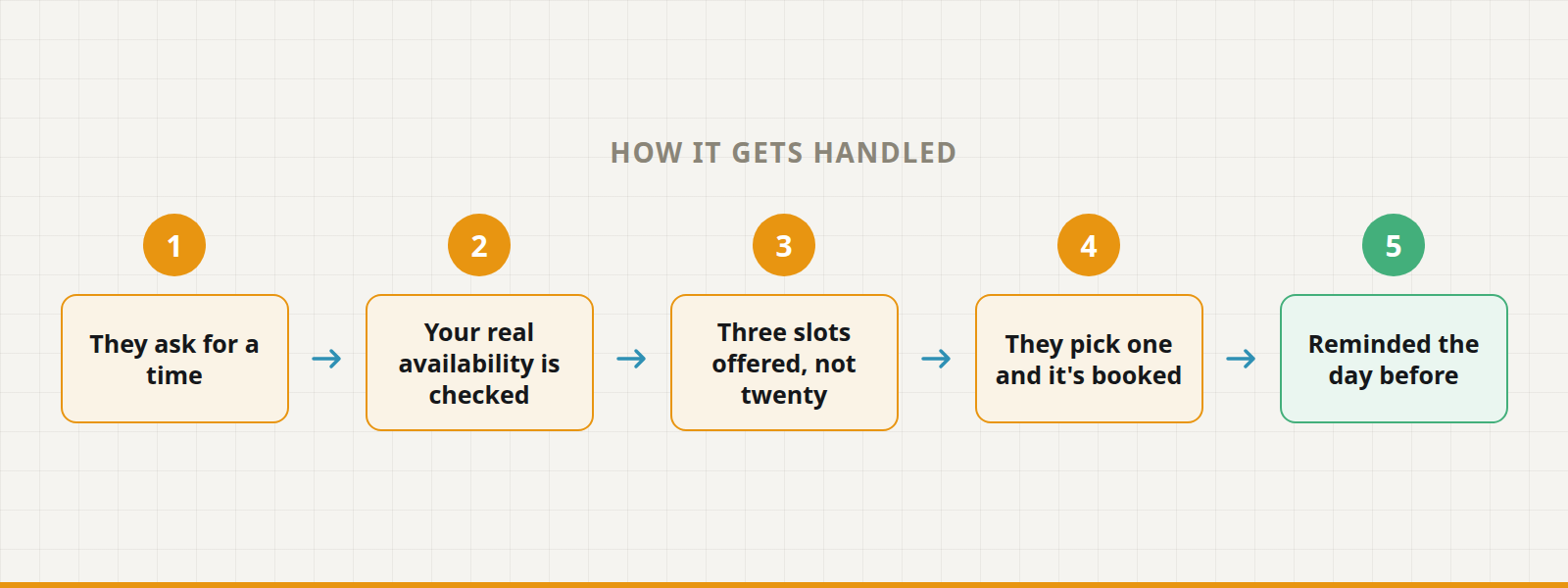
Here’s the order it actually happens in.
1. They ask for a time. By email, on WhatsApp, through the form on your site, in a reply to a quote you sent last week. However they asked, that’s where the conversation carries on.
2. Your real availability is checked. Not the gaps — the gaps that are actually workable. Travel between jobs, the hour you never book, the fact that Friday afternoons are for paperwork and you’d like them to stay that way.
3. Three slots offered, not twenty. A short list is answerable in one line. A whole month of availability is a decision, and decisions are what people put off until the evening and then forget.
4. They pick one and it’s booked. It goes in the diary, they get a confirmation with the address and anything they need to bring or do beforehand, and you get a line telling you it happened.
5. Reminded the day before. A short message the day before, with an easy way to move it. People don’t miss appointments because they don’t care. They miss them because it was a fortnight ago and nothing has mentioned it since.
The catalog card for this one is the Appointment Booker, and the description on it — your calendar, filled while you work — is about as literal as descriptions get.
A few versions of it:
The mobile dog groomer. Your day is a route, not a list. Two appointments that look fine in a calendar are impossible if one’s in town and the next is twenty minutes the other side of it, and you find that out at half eleven with a wet spaniel in the van. Slots only get offered where the day already puts you nearby, so the diary fills in a shape you can actually drive.
The tattoo studio. A half-sleeve is five hours and a small script piece is forty minutes, and treating them as the same booking is how a Saturday gets ruined. The length comes from what they’re asking for, the deposit is taken when the slot is held, and the chair isn’t held open for someone who hasn’t put anything behind it.
The building surveyor. Three diaries have to agree: yours, the agent who holds the keys, and the tenant who has to be in. That’s the rally squared, and it’s why inspections slip a week at a time. The times offered are the ones all three can do, so the first message you read is the one confirming it.
A diary that fills without the rally still has holes in it. Three empty slots tomorrow against a six-week waiting list is the other half of the same diary.
What it won’t do
It won’t book someone in that you’d rather look at first. Some enquiries you want to see yourself — the job that’s outside what you do, the customer you’ve had trouble with, the one that needs a phone call before it needs a slot. You mark those as ask-me-first and they come to you instead of getting a time.
Nothing goes out under your name without your say-so at the start. You read the offer wording and the confirmation until you’re happy with how they sound, then most owners let the routine ones run on their own and keep approval for anything unusual. Where that line sits is yours, and it moves back whenever you want it to.
It won’t fill a diary nobody’s asking about. If you’ve got space next week and nothing coming in, faster booking isn’t the problem you have. That one’s about where the enquiries come from, and no amount of tidy scheduling will stand in for it.
And it won’t stop people cancelling. A reminder catches the ones who forgot, which is most of them. It does nothing about the ones who changed their mind, and it can’t make a slot pay for itself once they have.
Stop playing email tennis to book an hour of your own time.
Operio builds and runs the AI workers that take a job like this off your desk — set up around how you actually work, watched over, and improved as it goes. You approve everything before it reaches a customer.
Or browse the full catalog of specialists to see what else can come off your plate.