
"Interested" turned into nothing. Again.
Nine enquiries, one person through the door, eighteen days empty. Here's how an enquiry on Sunday evening becomes a viewing somebody actually turns up to.

Nine people said they were interested in the flat on Bridge Street.
Four replied when you asked which day suited. Two agreed a time. One turned up.
He was very nice. He is also, it turns out, not moving until January.
The flat has been empty eighteen days now, and a decent part of that fortnight has gone on typing are you still interested? to people who were, briefly, on a Tuesday.
What eighteen empty days cost
The rent is the easy half. Whatever the flat brings in a month, divided by thirty, times eighteen — on a $1,500 flat that’s about $900, and void rent has the particular quality of never arriving late. You don’t earn it eventually. You just don’t earn it.
The other half is the typing. Nine enquiries, four messages each to land a single time: an offer, a no, a counter-offer, a confirmation. Call it an hour and a quarter. Then the three-quarters of an hour you spend standing in an empty kitchen at six on a Thursday, checking your phone, being stood up by a stranger. Two hours a property, $120 at $60 an hour, and it buys you nothing at all — it isn’t the viewing, it’s the scaffolding around the viewing.
And underneath both of those, the thing that actually costs you. The good ones move fast. The applicant who was ready to sign is the one who messaged at eight on Sunday evening and got your reply on Tuesday lunchtime, by which point she’d seen two other flats and liked one of them. You didn’t lose her on the property. You lost her on Monday.
Three weeks in you drop the rent by $50 to make something happen. That $50 isn’t a one-off. It’s every month of the next tenancy, and the one after that if they renew. An admin problem has quietly become a pricing decision.
How it gets handled
A viewing is four things: answer fast, find out whether they’re real, agree a time that exists, and make sure both parties remember it. None of it is difficult and all of it is time-sensitive, which is a bad combination for someone currently standing in a different flat.
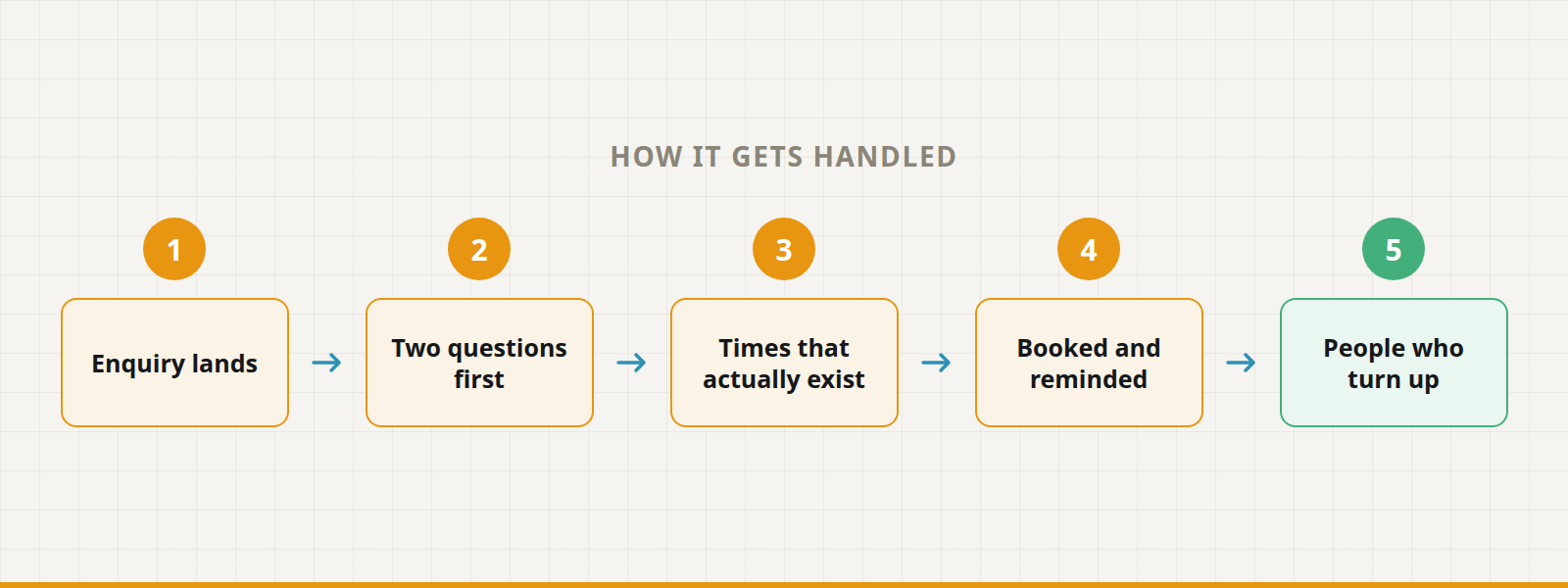
Here’s the order it actually happens in.
1. Enquiry lands. Portal, your own site, WhatsApp, the number on the board outside. It gets a reply in minutes, including at eight on a Sunday evening, which is when a good many of them arrive.
2. Two questions first. When do you need to move, and is there anything about the place that won’t work — the pets, the sharers, the parking, the budget, the fact that it’s a third-floor walk-up. Two questions, asked warmly, and the man who isn’t moving until January says so on Sunday rather than on your Thursday evening.
3. Times that actually exist. Offered from your real diary and the current tenant’s access windows, not invented and then withdrawn. Nobody is offered Tuesday at five if Tuesday at five is already a viewing at the other property.
4. Booked and reminded. A confirmation with the address and the door number, then a reminder on the morning with an easy way to cancel. A cancellation at nine is worth a great deal more to you than a no-show at six.
5. People who turn up. Which is, in the end, the only measure of any of this that matters.
In the catalog this is the Showing Scheduler. It answers on Sunday evening, which is most of the trick.
A few versions of it:
The agency with one negotiator. Every enquiry arrives while you’re standing in somebody’s hallway talking about their boiler. You reply at half past four; they booked two viewings elsewhere at half past one. The property was never the problem and the price was never the problem. The gap was three hours long.
The self-managing landlord. You block out Saturday morning, drive forty minutes, and two of the four don’t come. Reminders and a one-tap cancel don’t make people more reliable — they make the unreliability visible early enough to be useful. A gap you know about at nine on Friday is a gap you can offer to the next person on the list.
The room in a shared house. Three people already live there, and a stranger is about to walk through their kitchen. So a viewing time isn’t one diary, it’s four, and the decent thing — the only workable thing, really — is to ask them once which evenings are fine and then never book outside them. Set the windows once and that negotiation stops happening at all.
Two questions up front is what separates a viewing from a wasted evening. The trade version — an hour’s drive to somebody who was never going to buy — costs the same and stings more.
What it won’t do
References, affordability, the deposit, and the feeling you get in the hallway are yours, and they should stay yours. It fills the diary. It has no opinion about who’s standing in it.
It won’t stop people cancelling. Some of them still won’t come, and the ones who tell you at nine in the morning are a courtesy rather than a cure. The honest promise is that you find out earlier and are somewhere else instead of standing in an empty kitchen.
Nothing reaches an applicant without your say-so at the start. You read the first week of replies and the questions it asks, adjust the ones that sound off, then let the routine booking run itself while anything unusual still comes to you.
And it can’t let a flat that isn’t lettable. If eighteen days becomes thirty and the viewings are happening and nobody applies, it isn’t the booking. It’s the rent, the photographs, or the kitchen. You’ll reach that conclusion in a week instead of a month, which is worth having and is not the same as good news.
Stop asking nine people whether they’re still interested.
Operio builds and runs the AI workers that take a job like this off your desk — set up around how you actually work, watched over, and improved as it goes. You approve everything before it reaches a customer.
Or browse the full catalog of specialists to see what else can come off your plate.