
You drove an hour for someone who was never going to buy
Three site visits a week that were never going to be jobs is most of a day given away. Here's how the questions get asked before you put fuel in the van.

“We’re just getting a few prices,” she says, in the doorway, with the door not quite all the way open.
You’ve been driving since half seven. The van’s on a double yellow. You’ve got the folder with the good pen in it, and you already know how this ends — she’ll want a number today, she’ll take it to the man her brother-in-law knows, and you will never hear another word about it.
You measure up anyway. Forty minutes, because you’re not rude.
What the round trip actually cost
An hour out, forty minutes on site, an hour back. Two hours and forty minutes, door to door, which at $60 an hour is $160 of your own time, before the van, and there’s nobody to invoice for it.
Do that three times in a week and you’ve given away most of a day. Not to a competitor. To a conversation that could have happened on the phone in four minutes if anyone had asked one question first: what were you hoping to spend?
Nobody asks it. It feels rude, and it feels like the question of a man who isn’t busy. So you drive.
Then there’s the cost you never see, because it happened somewhere else. That same Thursday morning, somebody with a signed-off budget and a start date rang, got voicemail, and worked down the list to the next name. You were in a doorway two counties over, being told about the brother-in-law.
And after enough wasted mornings it starts showing up in your prices. You quote defensively, or you pad the ones that smell like time-wasters, or you stop going out at all for a while and lose three good ones to a mood. None of that is a pricing strategy. It’s just fatigue, priced in.
How it gets handled
This isn’t about being harder to reach. It’s about the four things you need to know before you put fuel in the van, asked at the one moment people are happy to answer them: right when they get in touch, not three days later.
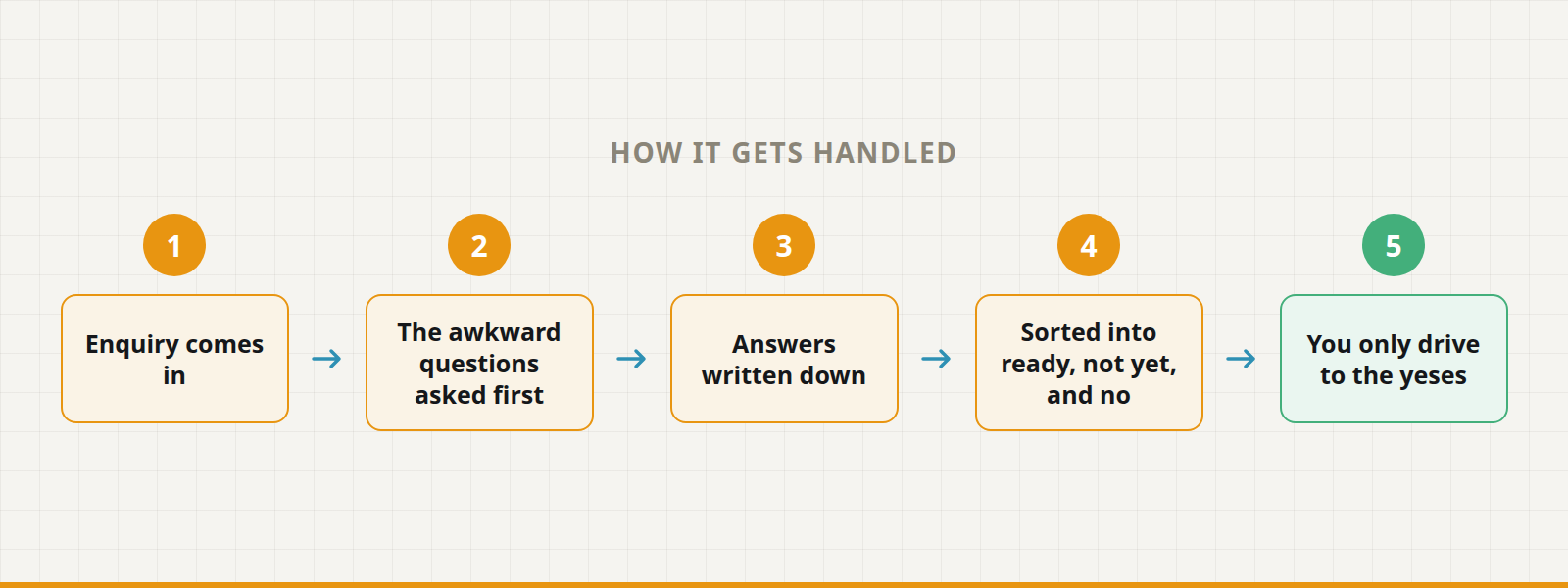
Here’s the order it actually happens in.
1. Enquiry comes in. The form, the phone, WhatsApp, the message off your Facebook page. Wherever they already reach you.
2. The awkward questions asked first. What the job is, where it is, when they want it, and the money one. Asked plainly, in your wording, as normal questions rather than a form. “Most jobs like this land between this and this — does that sound like the right neighbourhood?” gets answered. “What’s your budget?” doesn’t.
3. Answers written down. In one place, attached to the enquiry, so the next person to look at it isn’t starting from nothing. Photos too, where a photo saves an argument.
4. Sorted into ready, not yet, and no. Three piles, using rules you set once. The middle pile isn’t the bin — not yet comes with a date on it, and the date comes round.
5. You only drive to the yeses. Tuesday has two visits in it instead of five, and both of them are real.
Anyone who books time with strangers pays this tax. In lettings it’s nine enquiries and one person who actually turns up, which is the same hour of your life.
The catalog calls this one the Lead Qualifier. It asks the question you’ve never once enjoyed asking, in the same even tone every time, and it doesn’t mind at all what the answer is.
A few versions of it:
The kitchen fitter. Two enquiries land on the same Monday. One wants a full replacement and has a figure in mind that’s about a third of what a full replacement costs — and says so cheerfully, when asked, because nobody had told him. The other wants doors and worktops on the carcasses he’s got, with a number that works. You see the second one on Tuesday. The first gets an honest reply about what that money does buy, which sometimes becomes a job later and always becomes somebody who doesn’t badmouth you.
The removals firm. The price was never about the boxes. It’s about the stairs. Third floor, no lift, a permit needed for the van, and a piano nobody mentions until the morning. Those four get asked and answered before anything is quoted, with photos where it matters. The jobs that were always going to be a rotten day now get priced like one, or turned down on the Tuesday instead of discovered on the Saturday.
The IT support firm. Everyone who fills in your form wants “IT support”, and that means either a sole trader with a laptop or a thirty-person office with a server in a cupboard. Two questions sort it: how many people, and who looks after it now. The sole trader gets a straight answer about what you do and don’t do. The thirty-person office gets you, that afternoon.
What it won’t do
It doesn’t decide who you sell to. It sorts; you overrule. Every trade has the story about the browser in the paint-splattered fleece who turned out to own the barn — you’ll still take those calls, and you should. What changes is that it’s a choice now instead of the default.
Nothing reaches a customer without your say-so at the start. The questions are your questions, in your words, and you read the first few weeks of them before they go anywhere. Ask too many and people stop answering, so the list stays short. That’s a judgement you’ll want to make yourself.
It can’t make anyone tell the truth. Budgets get understated on purpose, and sometimes out of embarrassment. What you get is a much better guess than you had, not a guarantee. You’ll still drive out to the odd wasted morning. You’ll just do it in place of three.
And it won’t fix a price you’ve never decided. If you don’t know what your smallest worthwhile job is, there’s no question that sorts anything, because there’s no line to sort against. That’s an evening with a pen, and it’s yours to spend.
Stop giving away a day a week in windscreen time.
Operio builds and runs the AI workers that take a job like this off your desk — set up around how you actually work, watched over, and improved as it goes. You approve everything before it reaches a customer.
Or browse the full catalog of specialists to see what else can come off your plate.