
Forty people, Saturday, and no quote yet
Every catering enquiry costs an evening, and the ones you lose were lost by Wednesday. Here's how the quote goes out the same day, with your prices on it.

Quarter past eleven, kitchen table, calculator. You’re working out how many trays of the chicken thing feed forty people.
You’ve stopped, because you don’t actually know whether forty means forty. The email said “around forty, maybe forty-five”, didn’t say what time, didn’t say whether they want it dropped off or served, and mentioned at the end that one guest is vegan and a child can’t have dairy. So you’ll have to ask. Which means tomorrow. Which means they’ll have a price on Thursday.
Their event is Saturday.
The email came in on Monday.
What one quote actually takes
Time yourself honestly. Reading it properly, five minutes. Working out portions and what it costs you, fifteen. Writing it up so it looks like a business rather than a text message, fifteen. Call it forty minutes for a quote worth sending, and that’s before anybody replies asking what it would be for thirty-five instead.
Six enquiries in a week is an ordinary week. Four of them won’t book — some were price-checking, one was never real, one went to their cousin. At $60 an hour for your own time, six quotes is four hours and $240, and $160 of that went to people who were always going to say no.
Roughly a thousand dollars a month of evenings.
The money isn’t the sore part. The sore part is that the two who would have booked got their price on day four, by which time the caterer who answered on Monday has already had the conversation about the vegan and the child, and sounds like the safer pair of hands. Speed reads as competence in this trade. That isn’t fair and it is completely true.
And the quotes written at eleven at night are the ones priced wrong. Everybody knows which direction.
How it gets handled
Your prices stay your prices. Nothing here decides what a head is worth or what work you’ll take on. What changes is that the forty minutes of assembling a quote stops being yours, and the four-day gap closes to about an hour.
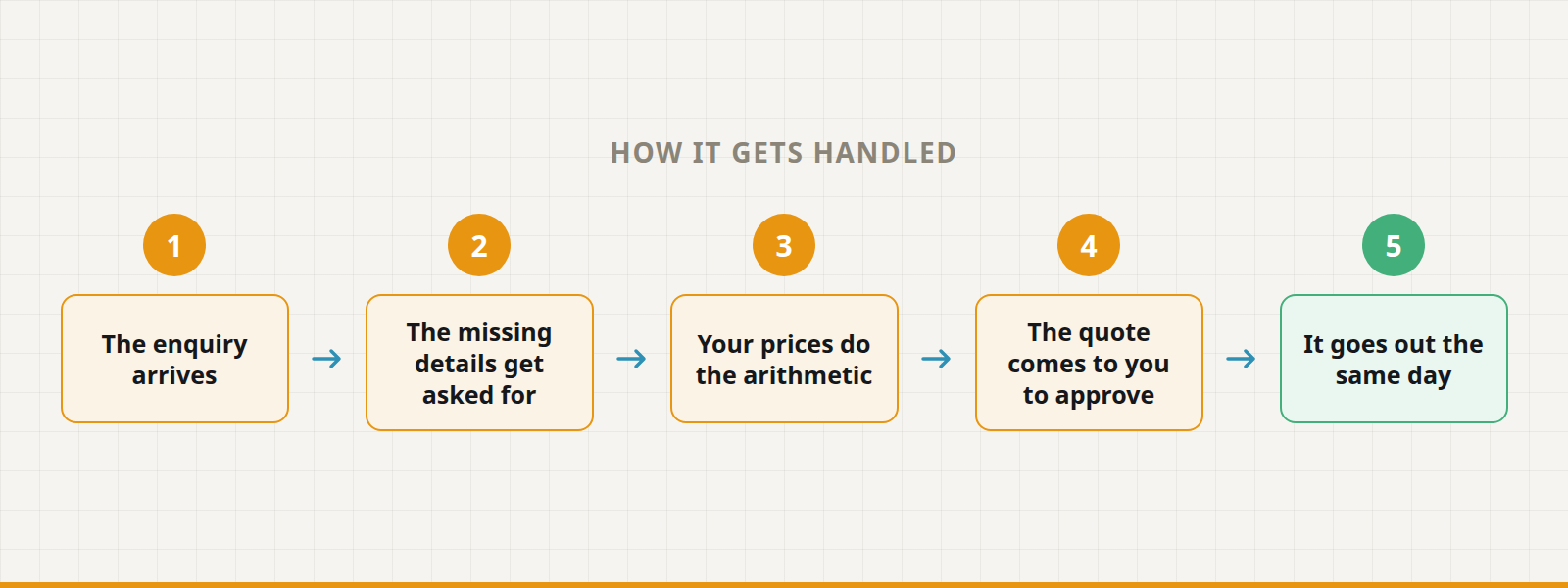
Here’s the order it actually happens in.
1. The enquiry arrives. From the website form, an email, a message, the number on the van. It gets read properly, including the bit at the end about the dairy.
2. The missing details get asked for. Time, place, headcount, dropped or served, plates or trays, dietaries, budget if they’ll say. One friendly message with the questions in it, sent within a few minutes, while they’re still thinking about you.
3. Your prices do the arithmetic. Per head, minimums, travel, staff if it’s served, the Saturday-in-December rate. Your numbers, your rules, applied the same way at midnight as at midday.
4. The quote comes to you to approve. On your phone, in something you can read in a minute. Change a line, add a note about the marquee, send it back for another go, or let it go.
5. It goes out the same day. Menu written out, what’s included, what isn’t, and how long the price holds.
The catalog lists this one as the Catering Coordinator. It does the assembling, not the deciding — which turns out to be about thirty-five of the forty minutes.
A few versions of it:
The office lunch run. Nine regular clients, drop-off platters, orders in by Thursday for the following week. The problem was never difficulty. It was that the same client got a slightly different price depending on who wrote the quote and how late it was, and one of them noticed. One set of numbers, applied the same way every time, and nobody has to remember what you charged them in March.
The marquee and hog roast job. These need a real conversation — access, power, whether there’s hard standing for the van — and until you’ve spent the evening you can’t tell whether it’s a genuine enquiry or someone collecting three prices for a party that won’t happen. Now the questions get asked on Monday morning, so by the time it reaches you, you can see which one it is before the evening goes into it.
The deli doing platters. Twenty small jobs a week, none of them worth forty minutes, all of them worth having. Sandwiches for a funeral, a birthday, a Tuesday board meeting. Each gets a written quote in ten minutes rather than a number said over the counter that you think about again at midnight.
Every business that prices each job on its own has this week. They asked for a price on Friday and it’s Tuesday is the same one, without the food.
What it won’t do
Pricing is yours, all of it. You set what a head costs, what your minimum is, what you charge to be somewhere at seven in the morning. It applies your numbers and stops when a job doesn’t fit them — a wedding for two hundred in a field on a hill is a phone call, and it says so instead of guessing.
Nothing goes to a customer without your say-so. Every quote waits for you at the start. Later you might let the standard platter jobs go straight out and hold approval on anything over a certain size, which is where most caterers end up. That line is yours to draw.
It won’t win work you’re too expensive for. Answering in an hour beats answering in four days more often than you’d expect, but it doesn’t beat a budget that was never there. What you get instead is finding that out on Monday rather than Thursday, which is worth something on its own.
And it can’t cost a menu you’ve never costed. If you don’t know what a tray of the chicken thing actually costs to make, quoting faster only sends the wrong number out sooner. That’s an afternoon with a spreadsheet, and nobody can do it but you.
Stop quoting at eleven at night.
Operio builds and runs the AI workers that take a job like this off your desk — set up around how you actually work, watched over, and improved as it goes. You approve everything before it reaches a customer.
Or browse the full catalog of specialists to see what else can come off your plate.