
They asked for a price on Friday. It's Tuesday.
The numbers are already in your head. Writing the quote up is what takes four days. Here's how it goes out while they still remember asking.

“Can you put a price together for the two bathrooms?”
Friday afternoon, on the doorstep, one foot already in the van. You said you’d get something across over the weekend, and you meant it. The job is straightforward. You’ve done forty like it. The numbers live in your head.
It’s Tuesday. The quote is a half-finished document behind six other tabs. The measurements are in a photo of a notepad. The tile price is in an email from March.
They’ve had two other quotes since. Both landed Monday morning.
What the four-day gap actually costs
Nobody pays you to write a quote. Say eight go out in a month, and each one takes forty minutes by the time you’ve dug out the last similar job, checked what materials cost this week, written the scope so it can’t be argued with in week three, and made the thing look like a business rather than a text message. That’s five hours and twenty minutes a month. At $60 an hour, call it $320 to tell people what things cost.
You’d pay that happily if the quotes went out on time. They don’t, and the reason isn’t laziness. Forty minutes is exactly the wrong length: too long for the gap between two jobs, too short to feel like it deserves an evening. So it moves to Sunday, and Sunday has its own ideas.
Then the money you never see, which is the larger number. You already know which of your quotes get accepted — the ones that arrive while the customer is still in the mood they were in when they asked. Four days later they’ve spoken to two other people, and you are no longer the person solving their problem. You’re the third price in a comparison.
The rushed ones cost you a second time. You round the labour down because you can’t face working it out properly at that hour. You forget the skip, the parking, the extra day for access. Then you win the job at the number you guessed at eleven at night, and you do it for that number all the way to the end.
How it gets handled
Nothing here changes how you price work. Your rates are your rates. What changes is that the writing-up — the part that is genuinely just assembly — stops waiting for you to have a free evening.
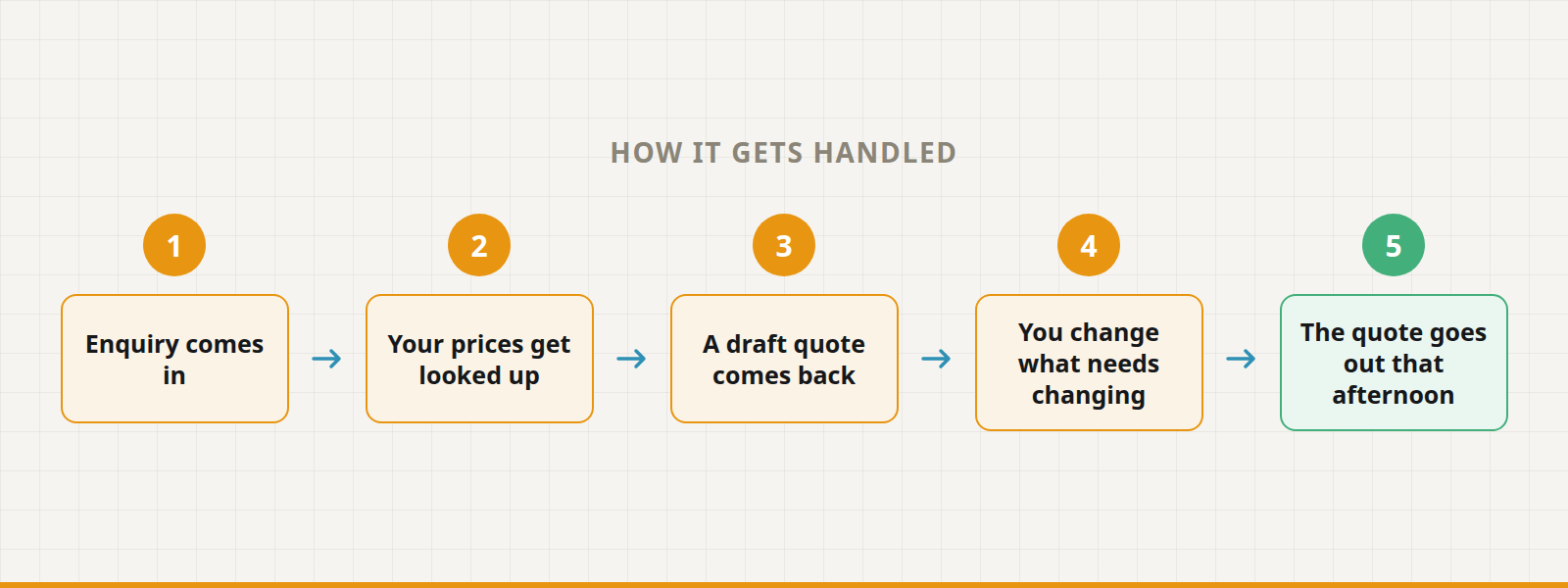
Here’s the order it actually happens in.
1. Enquiry comes in. However it arrives: the form on your site, a WhatsApp message, or two lines you dictate into your phone in the van outside. Photos and measurements go in with it.
2. Your prices get looked up. Your rate card, your materials list, and the three jobs from last year that were near enough the same. Nothing gets invented — if a number isn’t in what you’ve given it, the number doesn’t appear.
3. A draft quote comes back. Itemised, on your template, with your terms and your payment schedule at the bottom, and the scope written out in the boring detail that stops an argument later.
4. You change what needs changing. This is the part that stays yours: the awkward access, the customer you’d rather charge properly, the line you want worded differently. Usually about two minutes.
5. The quote goes out that afternoon. Sent, logged, and already on the list to be followed up if it goes quiet.
The catalog calls this one the Quote Builder — from enquiry to priced quote in minutes. Not a better price. The same price, on Friday.
A few versions of it:
The bathroom fitter. Domestic work, two or three quotes a week, every one of them racing whoever answers first. Friday’s doorstep conversation is drafted by Friday evening and sent Saturday morning, before the other two trades have opened a laptop. You didn’t get faster at your job. You just stopped being last.
The commercial cleaner. Every quote is a different building — floor area, how many nights a week, whether there’s a lift, who supplies the consumables. Twenty minutes of arithmetic, and you get it slightly wrong when you’re tired. The draft does that arithmetic the same way every time off the rates you set, and your twenty minutes goes on the question that actually matters, which is whether you want the contract at all.
The sign shop. Thirty small enquiries a week, most worth a few hundred dollars, none worth an hour of anyone’s afternoon. So they get a rough number over the phone and you find out afterwards that you were under. Now each one gets a real quote off the same price list, and the small jobs stop quietly subsidising the big ones.
Getting it out fast is half the job. The other half is what happens when the quote goes out and nothing comes back.
What it won’t do
What a job is worth stays a judgement, and judgement is yours. It applies the rates you gave it, and rates bend — the difficult client, the site with nowhere to park, the quiet week where you’d take the work at a number you wouldn’t look at in June. That call has never belonged to a rule, and it doesn’t now.
Nothing goes to a customer without your say-so. Every quote waits for you at the start. Once you’ve watched a few come back the way you’d have written them, most owners let the simple ones go straight out and keep approval on anything above a figure they choose. You pick that figure, and you can move it back down any time.
It can’t quote something nobody has looked at. If the job needs a site visit, it needs a site visit. What this closes is the gap between knowing the price and sending the price. The gap between not knowing and knowing is still a Tuesday morning in the van.
And it won’t rescue a rate card that’s wrong. If your margins are thin, quicker quotes lose money faster, which is worse and not better. Sit down with last year’s finished jobs first and work out what you actually made on them. That’s a different afternoon, and a more important one.
Stop writing quotes on a Sunday.
Operio builds and runs the AI workers that take a job like this off your desk — set up around how you actually work, watched over, and improved as it goes. You approve everything before it reaches a customer.
Or browse the full catalog of specialists to see what else can come off your plate.