
You still don't know how many are coming
Ninety invitations, forty-one replies, and final numbers due Thursday. Here's how the count ends up in one place you can trust, with the names behind it.

Ninety invitations. Forty-one replies.
The venue wants final numbers by Thursday, and final means final — over the count you pay for it, under it you’re carrying chairs in from the corridor. So you’re going down a list doing arithmetic on other people’s manners. The ones who said yes to your sister at a christening. The four who replied to an email address nobody checks. The one who said “we’ll try” in March. The nineteen who have never answered and won’t, unless somebody rings them.
It’s Tuesday.
What the guessing costs
The chasing is the cheap half. Forty-nine people, two minutes each to find them, work out what they’ve already been asked and write something that doesn’t sound impatient: that’s over an hour and a half, and it’s an hour and a half of your evening, because the evening is the only time anybody answers anything.
The expensive half is the number you guess at. Say the venue charges $48 a head and you round up by eight to be safe. That’s $384 for chairs nobody sits in and food nobody eats, and then a conversation with yourself about whether to mention it. Round down by eight and it’s worse: eight people standing at the back of a room you paid for.
Then the part that isn’t money at all. The list lives in four places — a spreadsheet, your text messages, an email folder, and the memory of whoever took three replies at the school gate. Nobody trusts the spreadsheet, including the person who made it. So the whole thing gets recounted every few days by hand, every recount turns something up, and none of it is work you would ever put on a timesheet.
How it gets handled
You keep the invitation you were going to send and the deadline you were going to set. What changes is that every reply — however it arrives, in whatever words — lands in the same count, and the count is right when you look at it.
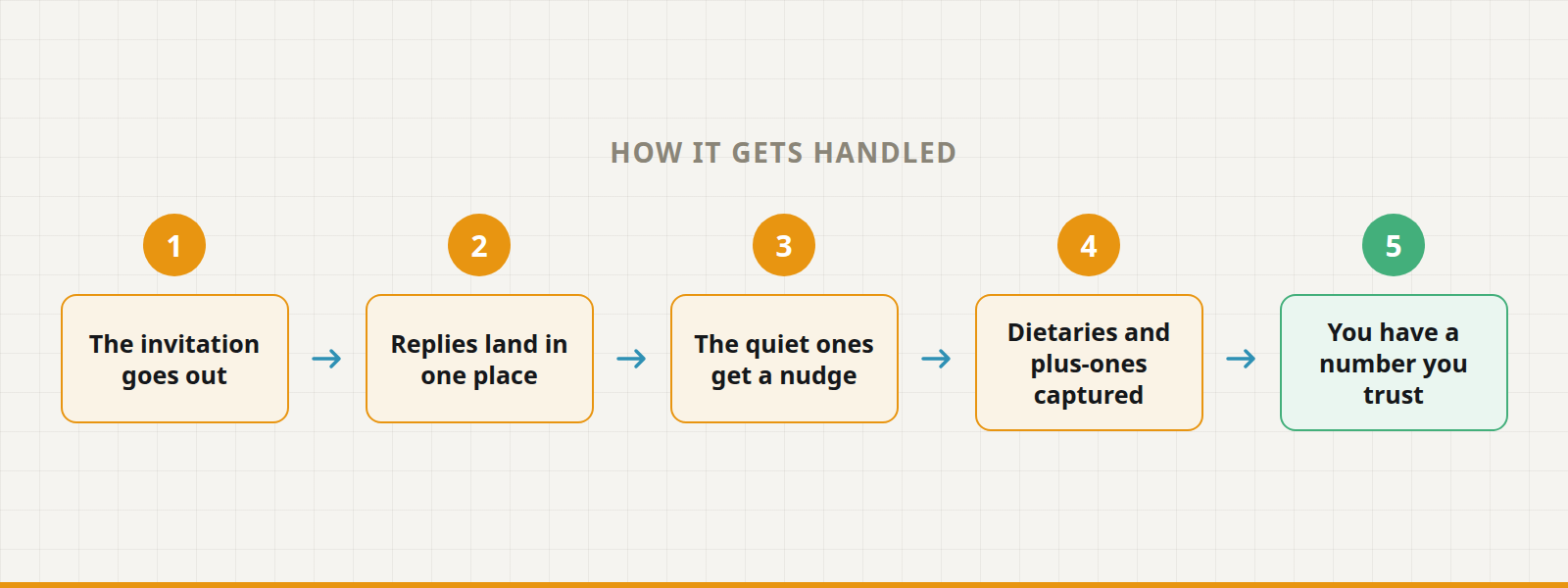
Here’s the order it actually happens in.
1. The invitation goes out. Your wording, your list, by email or message, with a way to reply that takes one tap and works on a phone at a bus stop.
2. Replies land in one place. The tidy ones and the ones that say “wouldn’t miss it!! is it ok if mum comes” — read, understood, and put on the same list.
3. The quiet ones get a nudge. A short reminder to the people who haven’t answered, and only them. Another, closer to the date, to the ones still quiet. Nobody who already replied gets asked twice, which is the bit people genuinely resent.
4. Dietaries and plus-ones captured. Asked at the moment they reply, rather than reconstructed in a panic on the Wednesday. Two vegetarians, one gluten-free, a high chair.
5. You have a number you trust. With the names behind it, so when the venue asks you say seventy-three and mean it.
In the catalog it’s the RSVP & Guest Manager, and the entire job is being the one place the count lives. It doesn’t mind sending a third reminder to somebody’s uncle, which is the part you were quietly dreading.
A few versions of it:
The wedding venue. The replies go to the couple, not to you, and the couple are busy being engaged. Numbers reach you second-hand, a fortnight old, in a text at half past nine at night. Here the count sits somewhere you both look at, moving as it moves, and you stop being the last to hear that the table of eight is now a table of five.
The charity dinner. Four ways to reply, because the committee wanted it that way: a Facebook event, paper slips at the back of the hall, the phone number on the poster, and Margaret. The replies were never the problem. The problem was four lists and no total. Now there’s one total, and Margaret’s are in it.
The free workshop. People say yes to free things easily and remember them poorly. A yes in March is a much softer thing than a yes on the Monday of the week itself, so those get a reconfirmation a few days out — which turns a good number of the maybes into a straight answer while there’s still time to offer the seat to somebody else.
A guest list and a class register are the same object. Half the class booked online and the other half texted you is this problem once a week instead of once a year.
What it won’t do
Some names on the list want a phone call, not a nudge. Your aunt, who has never replied to a written thing in her life and will absolutely be there. The client you’d rather ring than email. The friend going through something. You mark them, you handle them yourself, and the list leaves them alone.
Nothing goes out in your name without your say-so at the start. You read the invitation, the first nudge and the second one before any of them send. It sounds like whoever’s name is at the bottom, because that person wrote it.
It won’t make people reply. Some people don’t, ever, and no amount of polite reminding shifts that. What changes is that you know exactly who they are, by name, on the Monday instead of the Thursday — with time to make nine phone calls instead of guessing at nineteen.
And it can’t count a guest list that’s still being argued about. If the invitation never gave a date to reply by, or someone is still adding cousins in week three, there is no reliable number to be had and no system will invent one. That’s a conversation with your mother-in-law, and it isn’t a software problem.
Stop guessing at the numbers.
Operio builds and runs the AI workers that take a job like this off your desk — set up around how you actually work, watched over, and improved as it goes. You approve everything before it reaches a customer.
Or browse the full catalog of specialists to see what else can come off your plate.