
You're under a car and the phone won't stop
Every call you take costs five minutes of the job you're on. Every one you miss is a customer ringing somebody else. Here's how the counter gets covered.
You’re on your back under the nearside sill with a socket in one hand and a torch wedged into your shoulder, and the phone starts going on the bench. Four feet away. May as well be in another county.
You count the rings out of habit. Six, then it stops. Twenty seconds later it starts again, which means it’s either somebody who really wants something or the parts place calling back.
By the time you’re out from under and wiped down, the screen says two missed calls. Neither has left a message. Nobody leaves a message.
What the ringing actually costs
Twenty-five rings on a normal Tuesday. Maybe eight of those genuinely need you: a diagnosis, a price on an awkward job, a decision somebody has to actually make.
The other seventeen are: are you open Saturday, do you take cards, how much is a service on a 2016 hatchback, is my car ready yet, do you do courtesy cars, and is my car ready yet.
Every one you pick up costs three minutes on the phone and another two getting back into the job — because you don’t resume where you left off, you resume slightly behind it, checking the torque on the bolt you’re fairly sure you already did. Twelve of those a day is an hour. Six days is six hours a week, roughly $360 of your own time at $60 an hour, spent saying things you have said several thousand times before.
Then there’s the seventeen you don’t pick up. You already know what a missed call is worth, because at some point you’ve been the second number somebody rang. They don’t leave a message and they don’t try again in the afternoon. They ring the place on the next street, and if that goes well they’ve got a garage now, and it isn’t yours. You’ll never see that on any list of jobs you lost, because it never became a job.
And the fixed-price work quietly pays for all of it. The three-hour job that takes four because it was interrupted eleven times doesn’t get re-quoted. That hour comes out of you.
How it gets handled
Nothing about the workshop changes. Same number, same diary, same board on the wall. What changes is that the phone gets picked up on the second ring by something that knows your prices, your hours, and which cars are on the ramp.
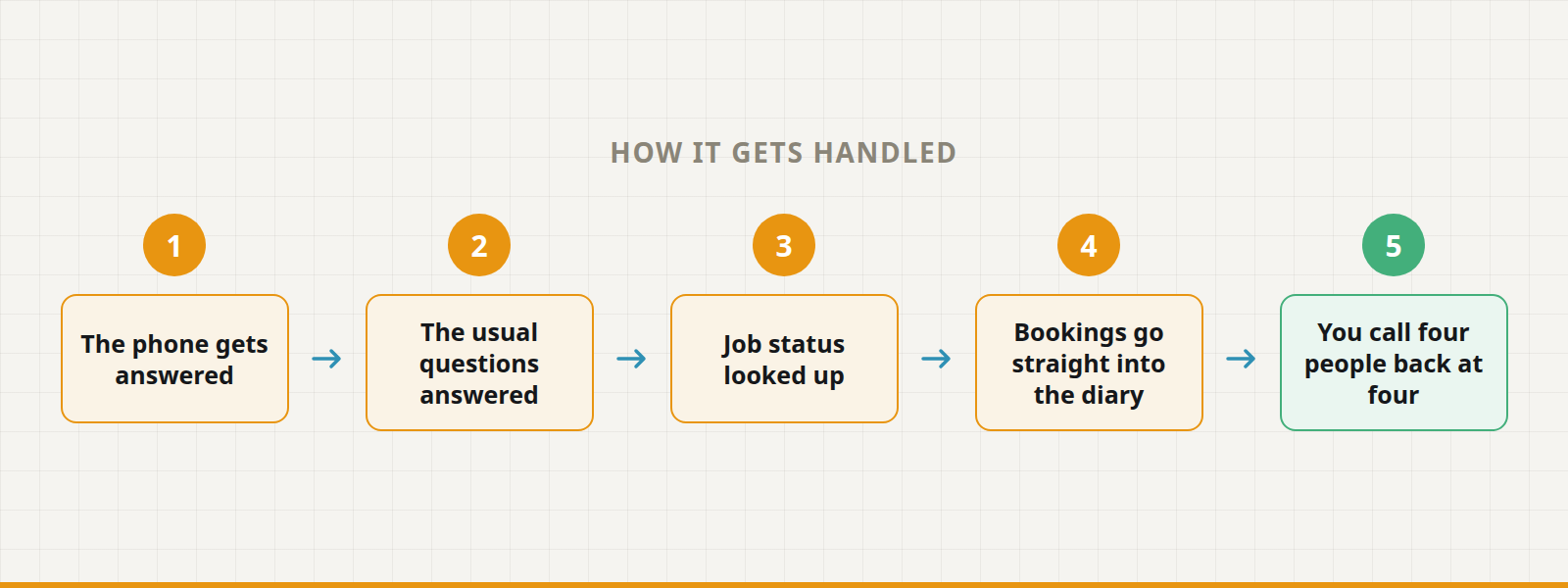
Here’s the order it actually happens in.
1. The phone gets answered. Every time, including the ones that come in at ten past one while you’re eating, and the ones after six that currently ring out into an empty unit.
2. The usual questions answered. On the spot, first time of asking. Opening hours, where to park, whether you take cards, what a standard service costs on a common car, how long you’d need it for. Your answers, in your words, taken from what you’ve already written down.
3. Job status looked up. Is it ready yet is the most common call you get and the easiest one to answer, provided somebody can see the job sheet. Ready, waiting on a part, part’s due Thursday — whatever the board says, without anybody walking over to look at the board.
4. Bookings go straight into the diary. With the registration, the mileage, what they think is wrong, and how long you’ll need the car — so the slot that gets booked is roughly the slot the work needs.
5. You call four people back at four. The ones that were always going to need you get held in a short list with the details already gathered. You do them in one go, at a time you chose, with clean hands.
In the catalog this one’s the Service Counter Agent — the person you’d hire for the front desk if the front desk generated enough work to justify a person, which it never quite does.
A few versions of it:
The bike shop on a Saturday. Someone’s at the counter holding a wheel and looking at you, and the phone is going behind you. Whichever one you choose, you’re being rude to the other, and the person standing in front of you is watching you make the decision. The phone stops being one of the two customers.
The joinery workshop. Extractor running, planer running, ear defenders on. It isn’t a choice between the phone and the work — for four hours at a stretch there is no version of you that can hear a phone, let alone hold a conversation about a kitchen. You come out at lunchtime to a list of what came in and what was already answered, and two names worth ringing.
The salon. Your hands are in somebody’s colour. Taking a call in front of them is a small insult to the person paying you to be present, so you don’t, and the call was somebody after a Saturday slot — the appointment you have the fewest of and can least afford to lose. It gets booked while you carry on with the head in front of you.
Every trade with its hands full has this. In a restaurant it’s a phone ringing all the way through dinner service, and it gets covered the same way.
What it won’t do
It doesn’t diagnose. There’s a knocking on left lock gets written down and booked in for someone to look at, not guessed at over the phone. A guess costs you a bay, a morning, and a customer who was told one thing and charged for another — so the guessing stays with the person who’ll be doing the work.
It won’t price the unknown. Settled prices, yes: a standard service, an inspection, an hourly rate, the common jobs on the common cars. It’s making a noise is not a price, and anything that isn’t on your list comes to you rather than getting a number invented for it.
Nothing goes to a customer without your say-so at the start. You listen to how it answers and read what it sends until it sounds like the place you actually run, then you let the ordinary calls go on their own and keep everything unusual for yourself.
And it can’t fix a full diary. If you’re booked three weeks out and the phone rings all day because people are waiting, answering faster tells them the bad news sooner. That’s a second ramp, a second pair of hands, or a price rise — and it’s a conversation worth having with the numbers in front of you rather than at half six on a Friday.
Stop climbing out from under a car to say you’re open till five.
Operio builds and runs the AI workers that take a job like this off your desk — set up around how you actually work, watched over, and improved as it goes. You approve everything before it reaches a customer.
Or browse the full catalog of specialists to see what else can come off your plate.