
The phone rang all through dinner service
The booking call always comes when nobody has a free hand. Here's how the phone gets answered on the second ring, right through service.
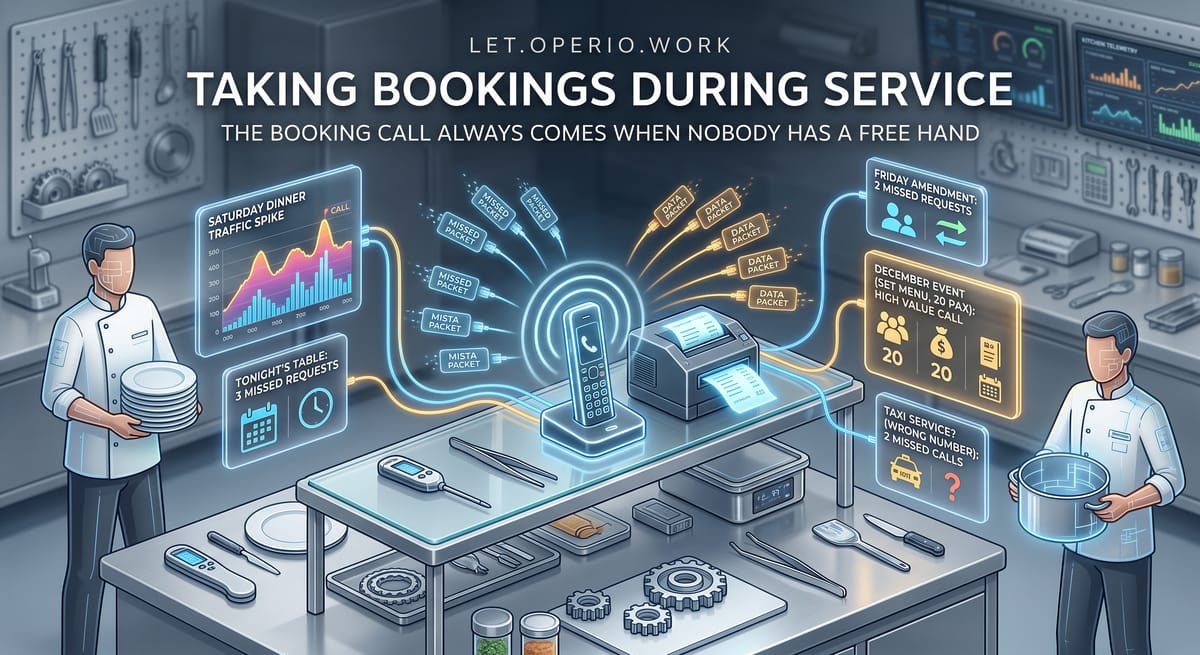
The phone lives on a shelf by the pass, next to the docket printer. Between seven and nine on a Saturday it rings eleven times.
Three of those want a table tonight. Two want to move Friday. One is asking whether you’d do a set menu for twenty in December, which is the most valuable call of the week and the one you have the least room for. Two have the wrong number for the taxi firm. The other three ring off before anyone gets to the shelf, because everybody in the room is carrying something.
You all hear it. You all keep moving.
What eleven rings on a Saturday cost
Start with the ones that ring off. Three a service, four services a week, and say half of them wanted a table — nobody is counting exactly, which is rather the point.
Put your own number against it. If a table of two spends $90 with you and you miss one a night, that’s $90 of capacity you had and didn’t sell. Four nights a week, fifty weeks: $18,000. It appears nowhere in your books, because missed calls don’t leave a record. They leave a slightly quieter Tuesday, and you blame the weather.
The calls you do answer aren’t free either. Ninety seconds off the floor, from somebody who was mid-something, four or five times a service. It’s the interruption more than the minute — everyone knows what happens to the table you were about to take an order from.
And the people ringing rather than using the widget on your website are ringing for a reason: a pram, a dog, a birthday, a wheelchair, six of them and one who is particular about where she sits. Those are the bookings with a question attached, which makes them precisely the ones that go elsewhere when nobody picks up.
The December call is the one that actually stings. A set menu for twenty is a night’s takings in a single conversation, and it went to voicemail. Nobody leaves voicemails now. They ring the next place on the list, and the next place answers, because the next place had somebody free.
How it gets handled
You don’t change your booking system and you don’t buy a tablet for the pass. The number on your window stays the number on your window. What changes is that somebody polite is always free to pick it up.
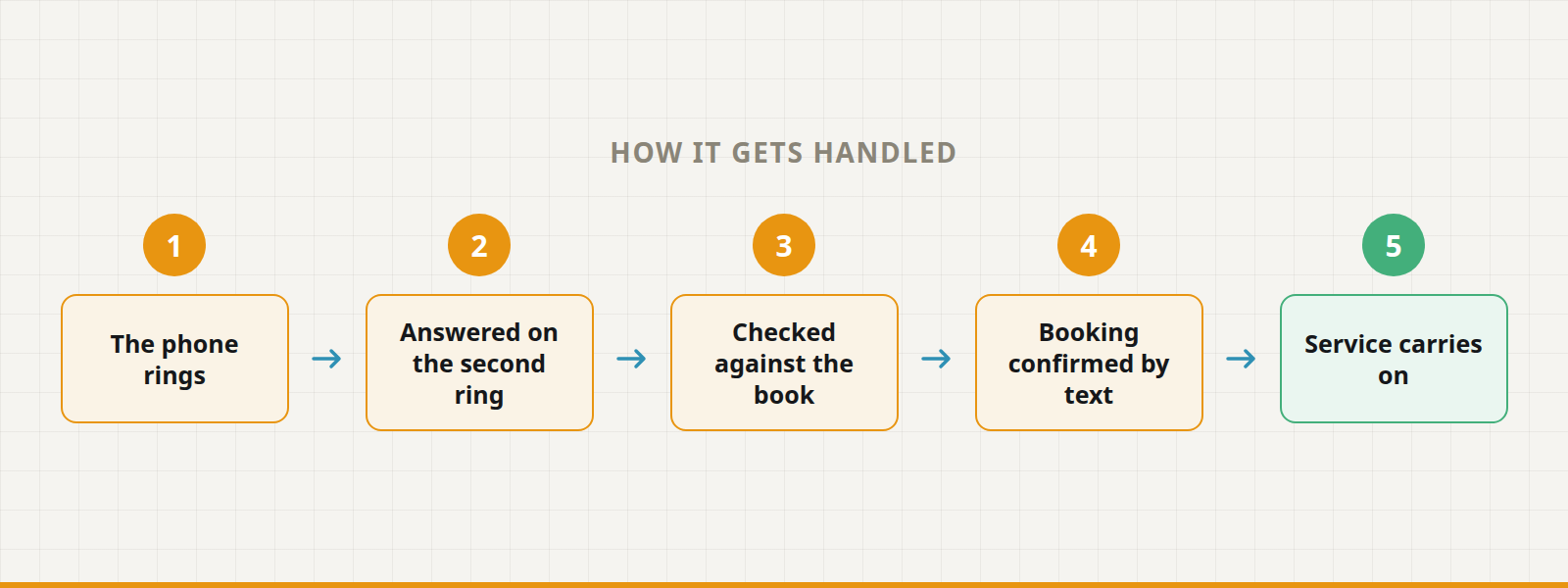
Here’s the order it actually happens in.
1. The phone rings. The same line, from the same listings, at the same hopeless moments it always did.
2. Answered on the second ring. A voice that knows your opening hours, where to park, whether you do a children’s menu, and that the kitchen stops at nine.
3. Checked against the book. Real availability, out of the booking system you already use. Table sizes, service times, the fact that Saturday at eight went a fortnight ago and quarter past seven didn’t.
4. Booking confirmed by text. Name, time, covers, and anything unusual, straight into the book, with a confirmation to the caller’s phone while they’re still holding it.
5. Service carries on. Nobody left the floor. The plates went out hot.
The catalog calls this one the Table & Event Host. It answers on the second ring at half past eight on a Saturday with precisely as much patience as it has at three on a Wednesday, which is the one part of the job no human being has ever managed.
A few versions of it:
The thirty-cover bistro. There is no spare person. There has never been a spare person. The phone gets answered by whoever is holding the fewest plates, which means it gets answered badly, and “have you got anything tonight?” gets a guess, because nobody has time to look at the book properly. Now the answer comes off the book instead of out of the air.
The pub with a function room. Most calls are “are you doing food Monday”. One of them is a wake for sixty. On a Saturday night both wait exactly the same length of time, which is the actual problem. The Monday question gets answered in ten seconds. The wake gets its questions asked — date, numbers, budget, sandwiches or hot — and lands on your phone as a proper enquiry with the details already in it.
The rooms above the restaurant. People ring at seven in the morning and half past ten at night, when there is nobody on the desk and there never will be. Those calls used to reach an answerphone that got listened to around lunchtime. Now they get a room, a rate and a confirmation, and you read what happened over your coffee.
Restaurants aren’t the only place where the phone rings while both hands are busy. A workshop with a car in the air has exactly this, minus the tablecloths.
What it won’t do
It won’t overrule you on the last table. Whether you hold the window for the couple who come every month, whether you squeeze six in at a quarter to nine, whether you take a Saturday booking from the party who didn’t show up last time — those are yours. It works the rules you give it and hands you anything that falls outside them.
Nothing goes out in your name without your say-so at the start. You approve the greeting, the confirmation text, and the wording it uses when it has to say no, because saying no well is most of the skill. Most owners spend a week getting that right and then stop thinking about it.
It won’t fill a quiet Tuesday. If the room is empty midweek, answering faster gets you a more complete record of nobody ringing. Midweek is a pricing question or a marketing one, and it’s a different conversation entirely.
And it doesn’t take the difficult calls. The complaint about Saturday, the regular who wants a rule bent, the party of twelve who’d like to bring their own cake and talk about the deposit — those come to you, with what’s already been said attached, so at least you’re not starting cold.
Stop answering the phone with a plate in your hand.
Operio builds and runs the AI workers that take a job like this off your desk — set up around how you actually work, watched over, and improved as it goes. You approve everything before it reaches a customer.
Or browse the full catalog of specialists to see what else can come off your plate.