
Five quotes out. None chased.
You did the site visit, the take-off and the Sunday evening pricing. The chase is the cheapest part of the job, and it's the part that never happens.
The extension you priced in April got built in July. You know because you drove past it — someone else’s board in the front garden, someone else’s van on the drive, and a job you’d have been glad of sitting there finished.
You never found out why. You never asked. The quote went out on a Thursday, you meant to ring the week after, and the week after had a leak in it.
There are four more like it in your sent items from this month alone.
What the unchased three cost
Say five quotes go out in a week and two come back yes. Of the three that don’t, you know the real reason for about one. The other two just went quiet, and quiet gets filed as a no.
Chasing them properly isn’t hard. It’s eight minutes each: find the quote, remind yourself what you offered, check you haven’t already chased, and write something that reads interested rather than desperate. Five of those is forty minutes a week. Over a year it’s thirty-odd hours, near enough $2,000 of your own time at $60 an hour — a real number, and still the wrong one to be looking at.
Look at this one instead. Before that quote went out you drove to the site, measured up, priced the materials and sat down on a Sunday evening to write it. The expensive part already happened. The chase is the cheapest thing you will ever do for that job, and it’s the only part that doesn’t get done.
There’s a second bill, paid later. If half your quotes vanish without a word, you’re guessing about your own prices. You shave a bit off the next one just in case, and win a job you’d have won anyway at the higher number. Silence doesn’t only cost you work. It costs you the information you’d need to stop losing it.
How it gets handled
Nothing changes about how you price or what you send. What changes is that the quote stops being finished the moment it leaves your outbox.
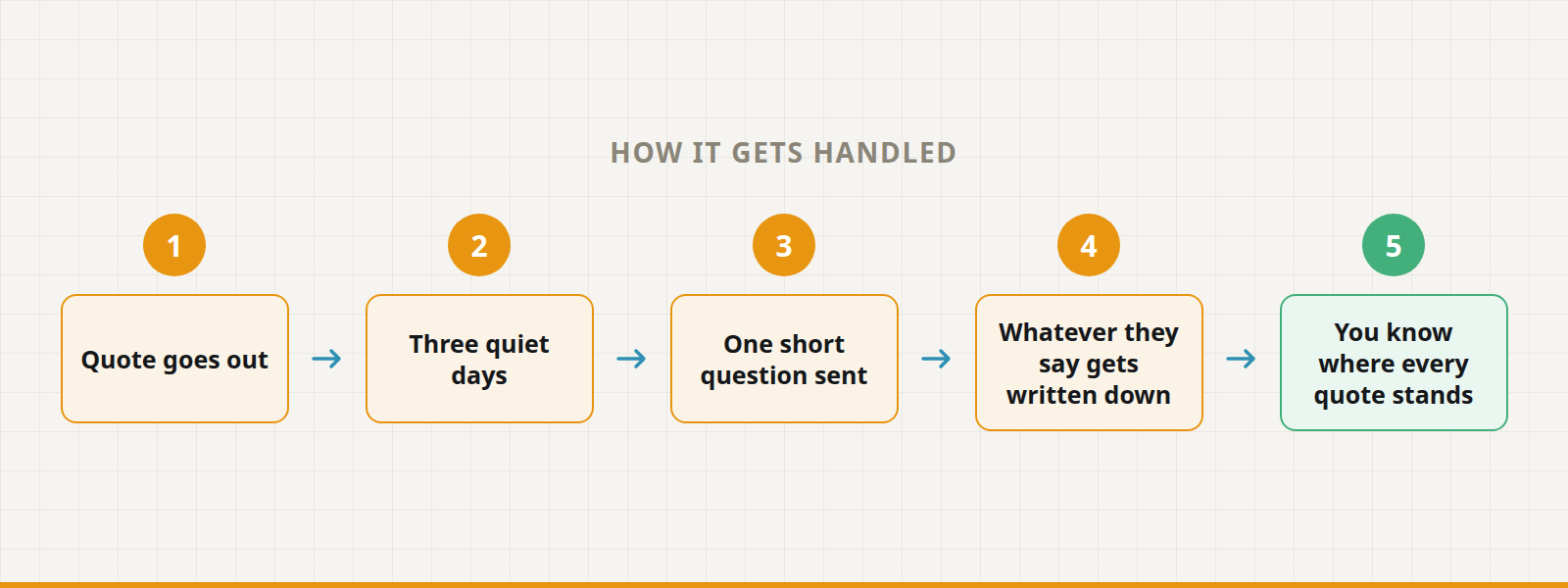
Here’s the order it actually happens in.
1. Quote goes out. Same document, same wording, same way you’ve always sent it. It just lands on a list as well, with the date and the number against it.
2. Three quiet days. If they say yes, it comes off the list and you never hear about any of this. If they don’t, a rhythm starts — three days, then a week, then a fortnight, then it stops. You set that once. It does stop, which is the part most owners want to hear.
3. One short question sent. Not “just following up”, which invites nothing and gets nothing. A question with something to answer: did the price land near where you expected? Or: do you want me to hold the week of the fourteenth?
4. Whatever they say gets written down. “Waiting on my wife.” “We’ve gone with someone else.” “Can you do it without the tiling?” All of it lands in one place, against that quote, so the next conversation starts where the last one finished.
5. You know where every quote stands. Live, dead, or waiting on something. Three columns instead of a folder and a bad feeling.
In the catalog this one is the Follow-up Chaser, and the entire skill is being willing to ask a third time without sounding wounded about it. That turns out to be rarer than it sounds.
A few versions of it:
The signage shop. Your quote is fine. Your customer’s landlord hasn’t approved the new fascia and won’t look at it for three weeks. That’s not a lost job, it’s a paused one, and the difference is invisible unless somebody asks. The day-three question gets you the real answer; the day-twenty-one one gets you the order.
The events caterer. You’re holding the second Saturday in June for a wedding that quoted in March and went quiet in April. Two other people have now asked about that date. The follow-up asks the only question that matters — are we going ahead, because I’ve had another enquiry for that day — and asks it while the answer is still useful to everybody involved.
The dental practice. The treatment plan was explained, printed and taken home. Then nothing, for five months, and it usually isn’t the money. It’s that booking it makes it real. A short note at a fortnight and again at six weeks, from the practice rather than from a stranger, is what turns a plan in a kitchen drawer into an appointment. Nobody on the front desk has to ring anyone at home.
Chasing works better when the quote went out quickly to begin with. Forty people, Saturday, and no price yet is the version of this that’s already lost by Wednesday.
What it won’t do
Selling is not on the list. When somebody comes back with “can you do it for less”, that’s a conversation with you in it — what you’ll move on, what you won’t, whether you want this job at that number. A follow-up gets you to the conversation. It has no business having it.
Nothing reaches a customer without your say-so at the start. You approve the wording, and most owners keep reading every message for a few weeks before they let the first nudge go out on its own. Where that line sits is yours, and you can pull it back.
It won’t rescue a quote that was wrong. Too dear, too slow, wrong scope, wrong reading of what they actually wanted — chasing that gets you a faster no. Faster is worth something. It is not a yes.
And it won’t tell you why you really lost. People are polite; “we went with someone else” is what you’ll get, and no amount of asking turns that into the truth. What you do get is thirty of those a year instead of five, and thirty short answers have a shape to them that five never did.
Stop letting good quotes go quiet.
Operio builds and runs the AI workers that take a job like this off your desk — set up around how you actually work, watched over, and improved as it goes. You approve everything before it reaches a customer.
Or browse the full catalog of specialists to see what else can come off your plate.