
The enquiry came in Sunday. The itinerary went out Thursday.
The enquiry lands Sunday night. The itinerary goes out Thursday, by which time they've booked elsewhere. Here's how it goes back the same evening.

Thursday, half past two, and you’re finally writing it.
The enquiry landed on Sunday at 9:14 in the evening. Four adults and two children, first week of September, some walking but nothing too steep, one of them doesn’t drive, and they’d rather not eat in the same place twice.
It was a good enquiry. Real people, real dates, money attached. It also needed about ninety minutes: the walks that suit a nine-year-old and a bad knee, which days the boat runs in September, somewhere that will take a table for six on a Saturday, and the two things you’d tell a friend to do that aren’t in any guidebook.
You didn’t have ninety minutes on Sunday night. Or Monday.
What Thursday costs
A proper itinerary takes ninety minutes, and five enquiries a week is seven and a half hours. A working day. At $60 an hour for your own time, $450. Two of the five will book, so around $270 of that went into documents nobody read past the price.
That’s the money, and it isn’t the expensive part. The gap is.
Somebody typing that message on a Sunday night is typing it to three or four places, because that is how anyone plans anything now. Whoever replies on Monday morning gets to have the conversation. By Thursday they have either booked with someone else or gone quiet in the particular way that means the same thing. You did the ninety minutes regardless.
Then there’s the retyping. The September walking week you wrote in June is very nearly the one you wrote in April, and the one before that. The good bits — the café that’s shut on Tuesdays, the path that floods after rain, the man with the boat — live in your head and get typed out fresh every time, slightly differently, occasionally forgotten altogether when it’s late.
How it gets handled
Nobody is inventing itineraries out of thin air here. What goes out is your local knowledge, your suppliers, your routes, assembled and written up while the enquiry is still warm — and then edited by you, because the edit is what makes it yours.
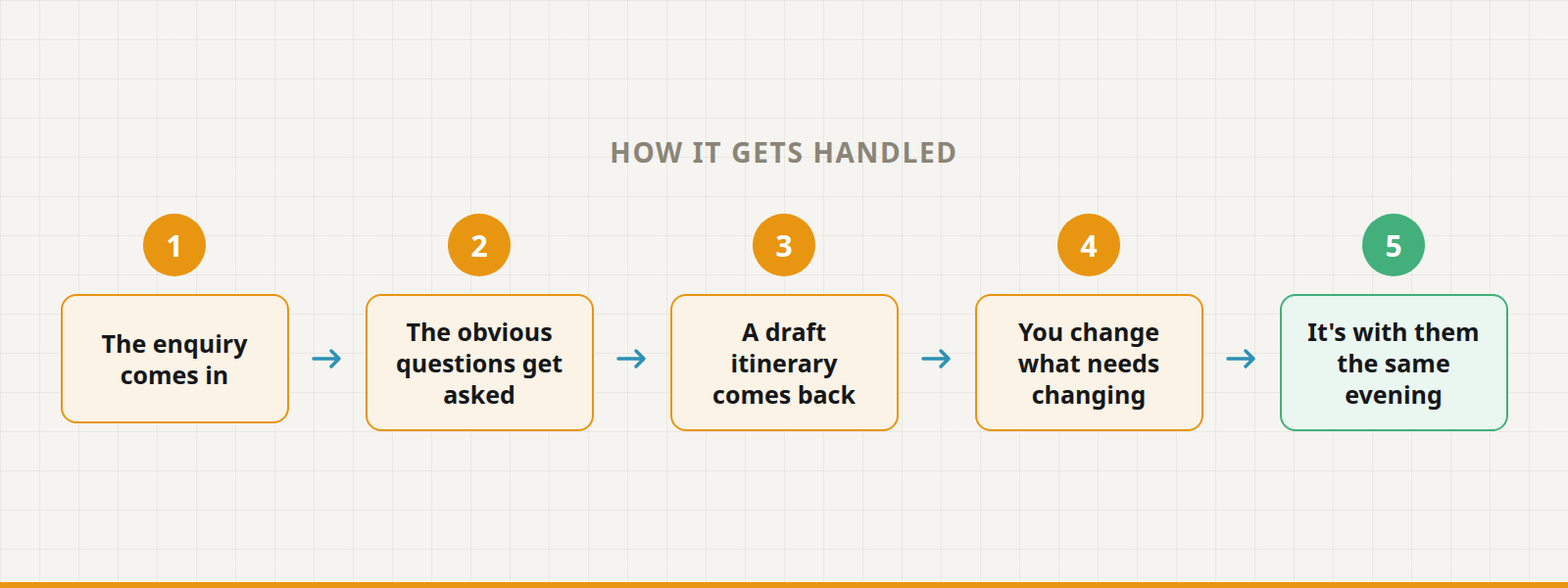
Here’s the order it actually happens in.
1. The enquiry comes in. Website form, email, a message at nine on a Sunday. It gets read properly: the ages, the knee, the one who doesn’t drive.
2. The obvious questions get asked. Dates confirmed, how they’re travelling, how hard they want it, what they’ve already booked. The questions you’d ask on the phone, sent within a few minutes of the message landing.
3. A draft itinerary comes back. Day by day, built from your own routes and places, with the practical parts filled in — distances, where to park, what’s shut on a Tuesday, which boat and when.
4. You change what needs changing. Swap the Thursday walk, take out the restaurant you’ve fallen out with, add the thing you’d only tell a friend. Ten minutes rather than ninety.
5. It’s with them the same evening. While they’re still at the kitchen table with the laptop open, deciding.
The catalog calls this one the Itinerary Builder. It’s a drafting job rather than a taste job: it does the typing and the timetables and leaves the choosing where it belongs.
A few versions of it:
The small walking-holiday outfit. Twelve routes, four bases, and every enquiry gets an itinerary built from scratch because every group is slightly different. The scratch part was always a bit of a fiction — it’s the same twelve routes, reassembled. Now the reassembly takes four minutes, and your evening goes to the one group that wants something genuinely unusual.
The fishing guide. Everything moves with the tide and the forecast, so the plan you sent in March is wrong by May and wrong again by the week itself. Rewriting it each time is exactly why guides stop sending plans at all. When the week shifts, the days re-cut around the new tides and go out again, and the client arrives knowing what’s happening on Wednesday.
The cottage with a Friday changeover. Guests ask what there is to do around here and get whatever the owner has the energy to type at the time. What they should get is the good version — the beach that’s better at low tide, the pub that serves food until nine, the farm shop, the walk from the back gate. Written down once, sent to everyone, with the dates and the season adjusted to suit.
An itinerary is a proposal with better scenery. The blank page that’s due tomorrow gets started the same way, out of work you’ve already done.
What it won’t do
Your patch isn’t in there until you put it there. It works from what you’ve written down: your routes, your suppliers, the café shut on Tuesdays. It can’t invent local knowledge and it won’t pretend to. Getting yours out of your head and onto a page is the setup, and it’s most of the work — it’s also the version of your knowledge that survives you having flu in July.
Nothing goes to a guest without your say-so. Every draft waits for you. Some operators stay that way permanently, because the ten-minute edit is where an itinerary stops reading like a brochure. Others let the straightforward enquiries go out on their own after a month or two. You choose, and you can change your mind.
It doesn’t sell the trip. The conversation that turns a maybe into a deposit — the one where you talk them out of the hard walk on day two, gently, without saying the child won’t manage it — is yours. A fast itinerary buys you that conversation. It doesn’t have it for you.
And it won’t fix a hold-up that isn’t the writing. If your itineraries take four days because you’re waiting on a boat operator who answers email on Fridays, drafting faster moves the queue along, not the date. Worth knowing which one you’ve actually got before you go fixing the wrong one.
Stop losing the Sunday enquiry to Thursday.
Operio builds and runs the AI workers that take a job like this off your desk — set up around how you actually work, watched over, and improved as it goes. You approve everything before it reaches a customer.
Or browse the full catalog of specialists to see what else can come off your plate.