
The proposal is due tomorrow and it's still a blank page
You were good on the phone about this job. Four of the five hours that follow are assembly. Here's how you start from a full page instead of an empty one.

Twenty past nine on a Thursday night. The document has been open since seven.
There’s a title on it. The title is the client’s name and the word Proposal, and under that is a cursor, which has been in the same place for a while.
The problem isn’t that you don’t know what to say. You talked about this job for forty minutes on Tuesday and you were good — you knew where the risk was, you knew what you’d do first, you knew exactly why the last firm made a mess of it. All of that is in your head, ready to go.
It’s due at five tomorrow.
What the blank page actually costs
This one only looks small until you put a year against it. Two proposals a month, five hours each by the time you’ve drafted it, hunted down the last similar document, and made it look like something a serious business would send. That’s a hundred and twenty hours. Three working weeks. At $60 an hour, $7,200 of your own time a year spent describing work instead of doing it.
Of those five hours, about one is genuinely yours — the part where you say what you’d do about their problem and why you’re the one to do it. The other four are assembly. Structure, terms, company background, the case study you know is in a folder somewhere with a name like final_v3.
The second cost is the proposals you never write. Anyone who has run a business for a few years has a list of jobs they didn’t bid because the deadline was Friday and Friday was already full. That isn’t a lost proposal. It’s a lost job, and you never see the invoice you didn’t send.
The third one stings the most. A proposal written between nine and midnight reads like a proposal written between nine and midnight. It’s thinnest exactly where it should be strongest, and the person reading it has no way of knowing how good you were about their problem on the phone on Tuesday.
How it gets handled
Nobody is writing your proposals for you. The argument for why they should hire you has to be yours — that’s the whole document. What changes is that you start from a full page instead of an empty one.
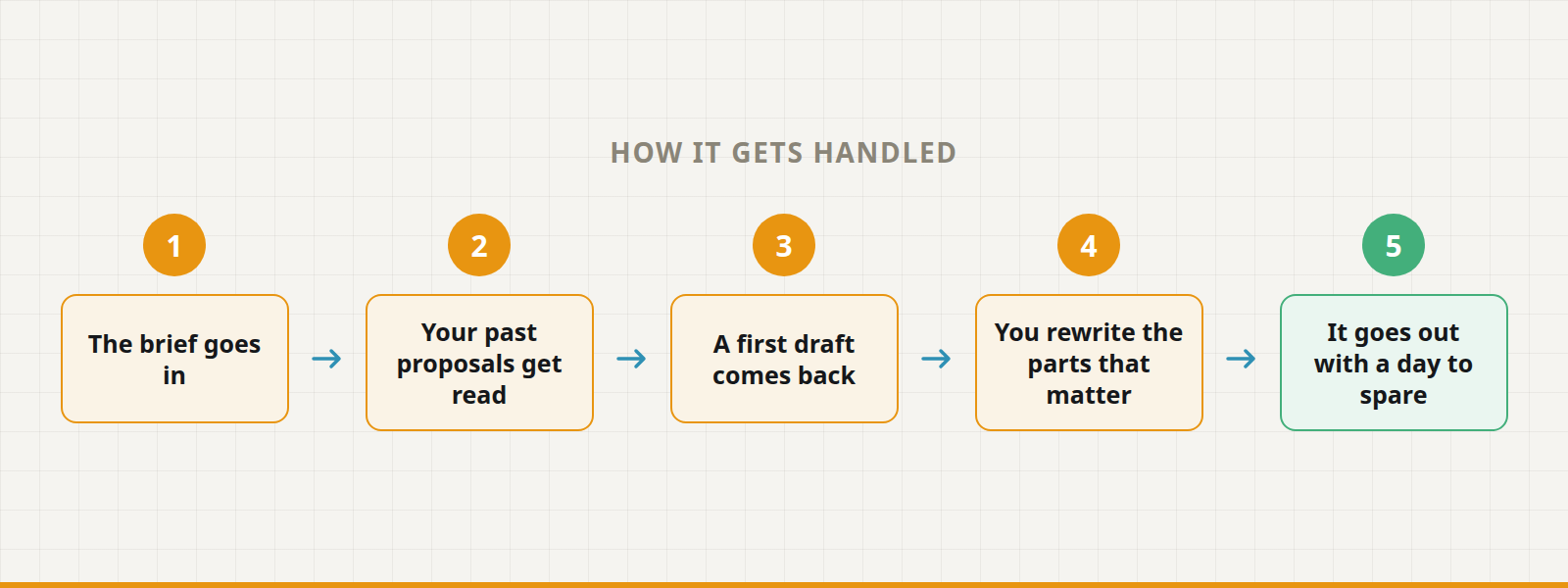
Here’s the order it actually happens in.
1. The brief goes in. Your notes from the call, the tender pack, the email chain, the photos from the site visit. Whatever you actually have, including if what you have is a voice note recorded in a car park.
2. Your past proposals get read. Specifically the ones you won. Your structure, your scope language, your terms, and the way you describe your own company on a day when you’re describing it well.
3. A first draft comes back. Sections filled in, priced off your rate card, the client’s own words about their problem put back in front of them — and a marked gap wherever something isn’t known, rather than a confident paragraph of nothing.
4. You rewrite the parts that matter. The approach, the judgement, the reason it’s you. One hour on the part that wins the work, instead of four on the part that merely doesn’t lose it.
5. It goes out with a day to spare. Formatted, checked against what the client actually asked for, and sent while the deadline is still theoretical.
The catalog card for this is the Proposal Writer, which oversells it a little. It writes the four hours you resent. You still write the hour that wins.
A few versions of it:
The security systems installer. Thirty pages, of which maybe six change between one job and the next — the device schedule, the site drawings, the commissioning plan. The rest is standards, warranties and method. Assembly used to mean an evening with an old document open beside a new one, hunting for the previous client’s name in the footer. Now the thirty pages arrive built and the evening goes on the six.
The training consultant. Nothing to assemble at all. Every proposal is genuinely different, which is exactly the problem: there’s no boilerplate to hide behind, so it’s a blank page every single time and you’d rather do almost anything else first. Starting from a structured draft in your own voice turns write a proposal into fix this proposal, and the same brain finds the second one far easier at nine at night.
The groundworks contractor. The proposal itself is two pages. The pack around it is twenty — forms, references, insurance certificates, method statements, the health and safety appendix that has to be in the format they specified. That pack is what makes the bid late, and it’s what gets checked against the requirements list before anything is sent, so nobody gets thrown out over a missing annexe.
Half of what makes a proposal good is wording you already wrote once, properly. Getting that paragraph back out of your own files is a job in itself.
What it won’t do
The job is won in one paragraph, and that paragraph is yours to write. What this client needs, how much risk you’ll carry, the price you’ll do it for — that’s the proposal. Everything else is packaging. A draft that shows up in twenty minutes is worth nothing at all if you send it without reading it properly, and it will read like it.
Nothing goes to a client without your say-so. There is no version of this where a proposal leaves your business unread. That isn’t a setting we’d advise against leaving on; it’s a setting that doesn’t exist.
It won’t know what you haven’t told it. Why you’d approach this job differently, the thing the client said off the record, the supplier you’d use and the reason — none of that is in your old documents. It leaves a gap and says so. Filling those gaps is the hour that matters.
And it can’t make you competitive on a job you shouldn’t be bidding for. Writing proposals faster means bidding more work, which is only good if the extra work is work you want at prices you’d be glad to win at. Sending twice as many proposals at the wrong price is a more efficient way to be busy and broke.
Stop starting from a blank page.
Operio builds and runs the AI workers that take a job like this off your desk — set up around how you actually work, watched over, and improved as it goes. You approve everything before it reaches a customer.
Or browse the full catalog of specialists to see what else can come off your plate.