
Forty people visited your site today. You know none of their names.
Forty visitors, no names, no messages. Here's how the people already on your site start a conversation instead of leaving quietly.
Forty people came to your website today. Two read all the way to the bottom of the page about the thing you’re actually best at. One got as far as the contact form, typed a first name, and stopped at the field asking for a phone number.
None of them are in your phone. None of them are in your inbox. Tomorrow there’ll be another forty, and the only ones you’ll ever meet are the few determined enough to ring during office hours.
In a shop you’d have at least seen their faces.
What the other thirty-nine cost you
Start with the two who did get in touch this week, because they’re the only ones you can count. Both wrote after nine at night. Both asked something the site already answers. Both took four messages back and forth before you knew whether there was a job in it — twenty minutes each of typing done in the gaps between other things, which is about $40 of your own time at $60 an hour.
That’s the cheap part, and you’d pay it happily. The expensive part is the thirty-eight who didn’t write.
You know roughly what one job is worth to you. Take that number, put it against a week where one of those forty would have booked if anyone had spoken to them, then put it against a year. It isn’t a rounding error. It’s the difference between the quiet Februaries and no quiet Februaries.
Then there’s the thing that makes every marketing decision a coin toss: most of what your website produces is silence, and silence teaches you nothing. You paid to get people there. They came. Nothing happened. So the next decision about where to spend gets made on a feeling, and you’ll be making it again in six months on the same feeling.
The form isn’t innocent in this, by the way. It asks for a full name, an email, a phone number and a message, from somebody who wanted to know one thing: whether you cover their postcode. Nobody fills in four fields to ask a one-field question. They mean to come back later. Later is a myth.
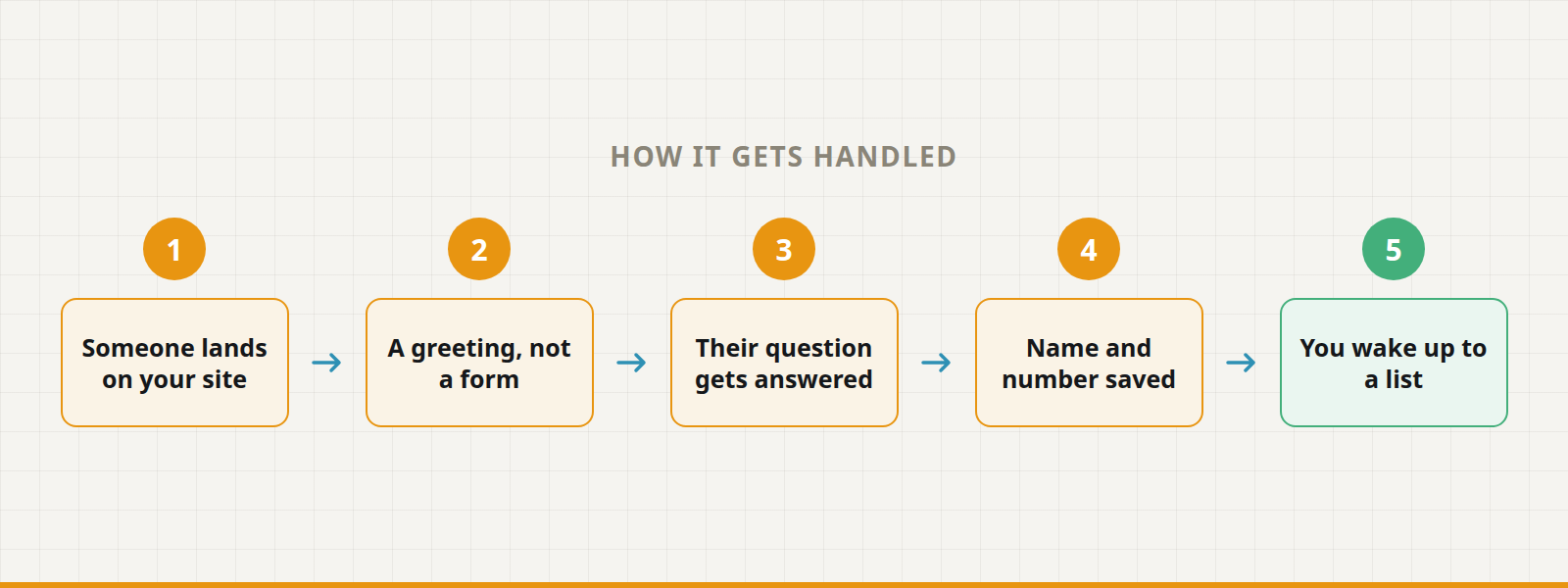
How it gets handled
Nothing here involves rebuilding the site. The pages stay as they are. What changes is that somebody is in the room when a visitor walks in.
Here’s the order it actually happens in.
1. Someone lands on your site. Nine at night, Sunday, on a phone, off the back of a photo a neighbour shared. The usual.
2. A greeting, not a form. One line in the corner. Not a pop-up thrown over the page they came to read, and not four fields. Closer to what you’d say if you looked up and saw somebody come through the door.
3. Their question gets answered. Do you cover this postcode, how far ahead are you booking, do you do small jobs or only big ones, is there a call-out charge. The settled answers get given straight away, in your words. Anything that isn’t settled gets marked for you rather than guessed at.
4. Name and number saved. Asked for once the conversation is worth having, which is the only moment anybody hands them over. It arrives with the whole exchange attached: what they asked, which page they were reading, what time it was.
5. You wake up to a list. Six names with a line each, instead of an empty inbox and a number on a chart.
The catalog calls this one the Lead Capture Agent, which slightly undersells the job. Most of it is simply being awake at nine on a Sunday — the hour people look for a tradesperson, and never the hour they ring one.
A few versions of it:
The roofer. The week after the storms your site gets a month of visitors in four days, all at once and none of them patient. Each one gets an answer in the same minute: yes, you’re taking emergency work; no, not before Thursday; here’s what a survey costs. By the time you’re down off a roof on Tuesday there are eleven names waiting, sorted by whose ceiling is currently wet.
The wedding photographer. The gallery gets looked at close to midnight, mostly by people getting married in fourteen months with nine tabs open. The first question is always the same one: are you free on the twelfth of September. That gets answered while they’re still scrolling the pictures, along with what a full day costs, and by morning you have a name, a date, and enough to know whether to pick up the phone.
The office cleaning company. Nobody fills in a form to ask a cleaning company for prices. They check three websites and ring whoever gave them a number. Yours gives a band — this much for a floor that size, this much again if it’s five nights instead of three — and asks how many desks. That’s a conversation, and a conversation is a lead. The other two got a contact form.
Getting the name is the first half. The second is what goes back, and how fast — a Sunday-night enquiry answered the same evening is where most of them are won or lost.
What it won’t do
It doesn’t decide who’s worth your time. Somebody wanting a job the other side of the county at a price that doesn’t work gets captured just as neatly as the good one. Sorting that out is a separate job, and the judgement in it stays yours either way.
Nothing reaches a customer without your say-so at the start. You read the answers before they go out for as long as you want to. Most owners spend a fortnight correcting wording, get comfortable, then let the plain factual answers go on their own and hold everything else. That line moves back whenever you like.
It won’t quote a price you haven’t set. If your call-out charge depends on the day, or you’ve never decided what the minimum job is, it says it’ll find out and passes the question to you. No inventing. (Half the value of setting this up is the afternoon you finally spend deciding those, and you’ll get that afternoon back inside a month.)
And it can’t fix traffic that was never going to buy. If forty people a day arrive because a post went around and none of them live within fifty miles of you, catching them faster just means learning that faster. Worth knowing. Not the same as more work.
Stop letting them leave without a word.
Operio builds and runs the AI workers that take a job like this off your desk — set up around how you actually work, watched over, and improved as it goes. You approve everything before it reaches a customer.
Or browse the full catalog of specialists to see what else can come off your plate.