
They wrote in Spanish and you replied a week later
The reply was good. It was also nine days late, which made it worth nothing. Here's how a message in any language gets answered the same hour.

The reply you finally sent was good.
You had it translated properly. You answered both her questions and you got the tone right — friendly rather than formal, which is a hard thing to be sure of in a language you don’t speak.
It went out on the twelfth. Her message came in on the third.
Nine days, because the first thing you did was decide it needed somebody who speaks Spanish. The second thing you did was not know anybody. Then it was Thursday, then there was a job on, then it was the weekend, and it moved down the screen the way things do.
What nine days actually costs
The ones you do answer already cost you. If a handful of messages a month arrive in a language you don’t work in, and each costs you twenty minutes — paste it into a translator, read the output, doubt the output, rewrite it, wonder whether the polite version reads as cold — that’s about an hour a month. Sixty dollars of your own time, for replies you still aren’t confident in.
That isn’t the expensive part either.
The expensive part is the ones that never get answered. Twenty minutes of uncertainty is easy to put off, and putting it off is what actually happens, because there is always a message in your own language you can deal with right now. So they sit. And an enquiry that sits for nine days isn’t a slow enquiry. It’s somebody else’s customer: she wrote to three places and one of them replied on the third.
The obvious fix is to hire somebody who speaks it. That’s a wage, for one language, during the hours that person is at work. The messages arrive in four languages at eleven at night.
Then there’s the part with no number on it. She was perfectly nice about the delay. Next time she wrote in careful, effortful English so as not to be a nuisance, which meant the two of you understood each other slightly less well than before. That’s a customer being careful with you. It isn’t the relationship you wanted.
How it gets handled
This isn’t a translate button on your website. It’s the job your front desk does — read the message, answer it properly, hand you the ones that need you — done in whatever language the message turned up in.
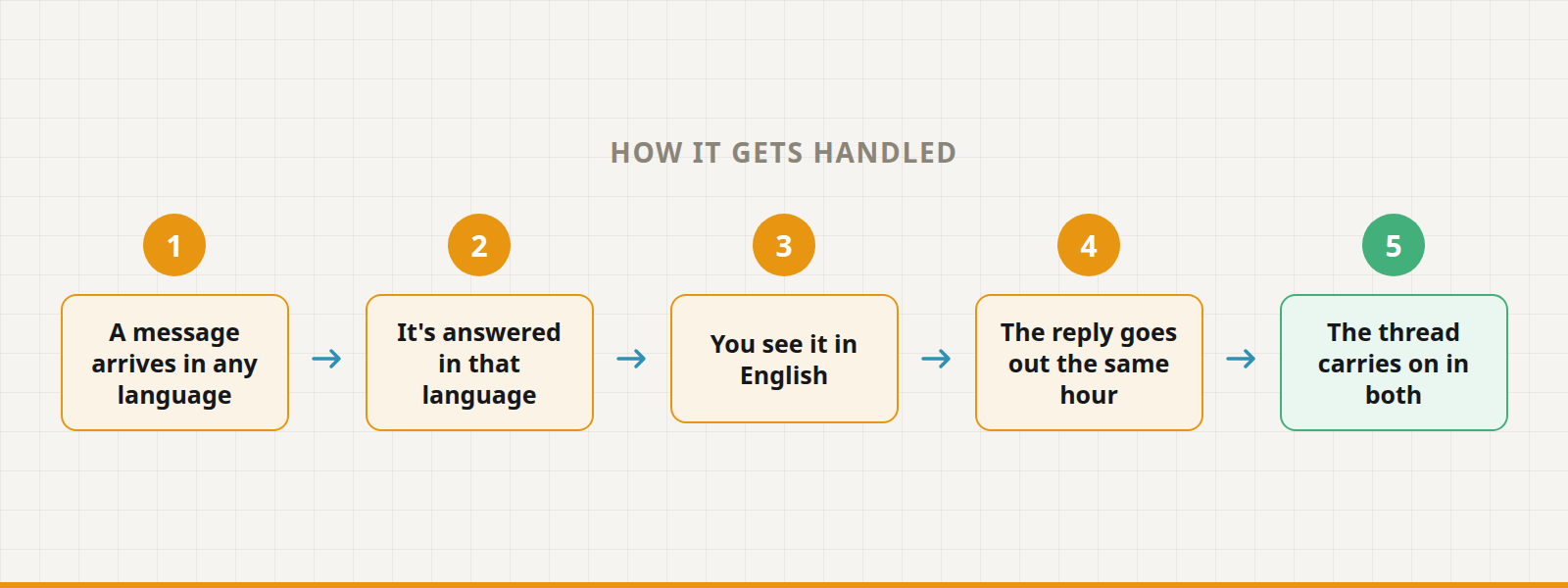
Here’s the order it actually happens in.
1. A message arrives in any language. Email, the website form, WhatsApp, wherever your customers actually write to you. Nobody has to pick a flag from a menu first.
2. It’s answered in that language. Not your English pushed word for word through a machine, which is how you end up sounding like an instruction manual. Written in their language, from what you’ve written down: hours, prices, where to park, what happens on arrival, the answer to the question they actually asked.
3. You see it in English. Side by side, before it goes. You can read what is about to be said on your behalf in a language you don’t have, which is the only way any of this is ever going to sit comfortably.
4. The reply goes out the same hour. Not the twelfth. While she’s still deciding.
5. The thread carries on in both. Whatever comes back is answered in their language and filed in yours, so anybody in your business can pick the conversation up without starting it again.
The catalog calls this one the Multilingual Concierge: every client answered in their language. In practice it’s the difference between a business that takes enquiries in Spanish and a business that always meant to.
A few versions of it:
The holiday let. Guests from four countries in a season, and the messages that matter most are the dull practical ones — the key box code, which bin goes out on Tuesday, the door that sticks if you pull it. The eleven o’clock message from somebody standing outside your cottage in the rain is not a message that waits until morning, in any language.
The clinic with overseas patients. A first enquiry about a procedure, in Portuguese, from somebody who has been thinking about it for two years and has written to four places. The reply needs to arrive today, sound like a clinic rather than a brochure, and stop short of anything clinical — which it does, because the price list and the what-happens-on-the-day page are written down and the medical questions are not its to answer.
The parts supplier. A purchase enquiry in German with a part number, a tolerance and a delivery date on it. Speed matters, but being right matters more. The routine half gets answered — stock, lead time, freight — and the specification question goes to the engineer, in English, with the original attached. Nobody guesses at a tolerance in a second language.
Reviews arrive in other languages too, and an unanswered one reads the same in all of them. A one-star review sitting there nine days is the version everybody can see.
What it won’t do
Nobody should put words in your mouth in a language you can’t check. That’s the honest shape of this: for the languages you don’t read, you are trusting the reply. So it stays on the settled answers — hours, prices, directions, what happens next — and anything that makes a promise, quotes an unusual price or touches a contract comes to you first, in English, next to the version that’s about to send.
Nothing reaches a customer without your say-so at the start. You approve every message until the routine ones sound the way you’d say them yourself, then you let those run and keep approval on the rest. Where that line sits is yours, and you can move it back.
It doesn’t make you a business that operates in that language. If she rings, somebody still has to answer the phone. If a booking goes wrong at midnight, a person sorts it out, and that person still speaks what they speak. Written enquiries are a wide door. They aren’t the only one.
And it won’t fix an answer that was bad in English. If your arrival instructions confuse people in your own language, they will confuse people in four more. All you’ll have done is confuse them promptly.
Stop letting a good answer arrive nine days late.
Operio builds and runs the AI workers that take a job like this off your desk — set up around how you actually work, watched over, and improved as it goes. You approve everything before it reaches a customer.
Or browse the full catalog of specialists to see what else can come off your plate.